Pearson+ LogoPearson+ Logo
Ch.17 Carboxylic Acids and Their Derivatives
McMurry - Fundamentals of GOB 8th Edition
McMurry8th EditionFundamentals of GOBISBN: 9780134015187Not the one you use?Change textbook
Chapter 17, Problem 28a

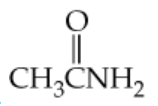
Identify the functional group in the following compounds and give the structures of the products of hydrolysis for these compounds.
a. Chemical structure of an amide, showing the carbonyl group and an amine group attached to a methyl group.

Verified step by step guidance
1
Step 1: Understand the problem. Hydrolysis is a chemical reaction where a compound reacts with water, often breaking a bond and forming two or more products. Functional groups are specific groups of atoms within molecules that determine the chemical reactivity of those molecules. Common functional groups include esters, amides, and others that can undergo hydrolysis.
Step 2: Identify the functional group in the compound. Examine the structure of the compound (provided in the image) to determine the functional group. For example, if the compound contains a carbonyl group (C=O) bonded to an oxygen atom (O) and another carbon chain, it is likely an ester. If it contains a carbonyl group bonded to a nitrogen atom (N), it is likely an amide.
Step 3: Write the general reaction for hydrolysis of the identified functional group. For example, the hydrolysis of an ester in the presence of water typically produces a carboxylic acid and an alcohol. The hydrolysis of an amide typically produces a carboxylic acid and an amine.
Step 4: Apply the specific structure of the compound to the general hydrolysis reaction. Replace the generic R groups in the general reaction with the specific groups from the compound in the image. This will give you the structures of the hydrolysis products.
Step 5: Verify the products. Ensure that the products you have written are consistent with the functional group identified and the reaction mechanism of hydrolysis. Double-check the connectivity of atoms and the presence of any charges or lone pairs if applicable.

Verified video answer for a similar problem:

This video solution was recommended by our tutors as helpful for the problem above.
Was this helpful?

Key Concepts

Here are the essential concepts you must grasp in order to answer the question correctly.

Functional Groups

Functional groups are specific groups of atoms within molecules that are responsible for the characteristic chemical reactions of those molecules. They determine the properties and reactivity of organic compounds. Common functional groups include hydroxyl (-OH), carboxyl (-COOH), and amine (-NH2), each influencing the behavior of the compound in chemical reactions.
Recommended video:
Guided course
1:11
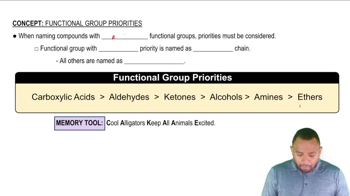
Functional Group Priorities Concept 1

Hydrolysis

Hydrolysis is a chemical reaction in which water is used to break down a compound. In organic chemistry, it often involves the cleavage of bonds in larger molecules, resulting in the formation of smaller molecules. For example, esters can be hydrolyzed to produce an alcohol and a carboxylic acid, illustrating how water can facilitate the transformation of compounds.
Recommended video:
Guided course
1:12
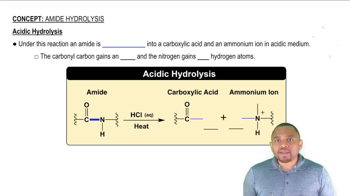
Acidic Hydrolysis Concept 1

Product Structures

The product structures refer to the molecular configurations that result from a chemical reaction. In the context of hydrolysis, understanding the product structures involves knowing how the original compound is altered and what new functional groups are formed. Drawing these structures requires knowledge of molecular geometry and the ability to represent chemical bonds accurately.
Recommended video:
Guided course
01:37
Solubility Product Constant (Ksp) Concept 2