Pearson+ LogoPearson+ Logo
Ch.11 Nucleic Acids Big Molecules with a Big Role
Frost - General, Organic and Biological Chemistry 4th Edition
Frost4th EditionGeneral, Organic and Biological ChemistryISBN: 9780134988696Not the one you use?Change textbook
Chapter 7, Problem 19b

Write the base sequence and label the 3' and 5' ends of the complementary strand for a segment of DNA with the following base sequences:
b. 5'CCCCTTTT3'

Verified step by step guidance
1
Identify the complementary base pairing rules for DNA: Cytosine (C) pairs with Guanine (G), and Thymine (T) pairs with Adenine (A).
Write the complementary strand by replacing each base in the given sequence with its complementary base: C → G, T → A.
Reverse the direction of the complementary strand to ensure it is antiparallel to the original strand. The original strand is 5' to 3', so the complementary strand will be 3' to 5'.
Label the ends of the complementary strand appropriately: the 3' end corresponds to the start of the complementary sequence, and the 5' end corresponds to the end of the complementary sequence.
Combine the complementary bases and their labels to finalize the complementary strand: 3'GGGGAAAA5'.

Verified video answer for a similar problem:

This video solution was recommended by our tutors as helpful for the problem above.
Video duration:
3m
Was this helpful?

Key Concepts

Here are the essential concepts you must grasp in order to answer the question correctly.

DNA Structure

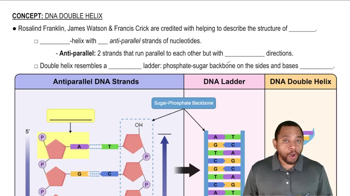
DNA is composed of two strands that form a double helix, with each strand made up of nucleotides. Each nucleotide consists of a sugar, a phosphate group, and a nitrogenous base. The strands are oriented in opposite directions, with one running 5' to 3' and the other 3' to 5'. This antiparallel arrangement is crucial for DNA replication and function.
Recommended video:
Guided course
3:27
DNA Double Helix Concept 1

Base Pairing Rules

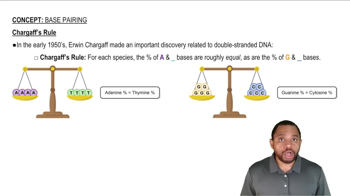
In DNA, nitrogenous bases pair specifically: adenine (A) pairs with thymine (T), and cytosine (C) pairs with guanine (G). This complementary base pairing is essential for the accurate replication of DNA and the transmission of genetic information. Understanding these rules is necessary to determine the complementary strand from a given DNA sequence.
Recommended video:
Guided course
2:01
Base Pairing Concept 2

5' and 3' Ends

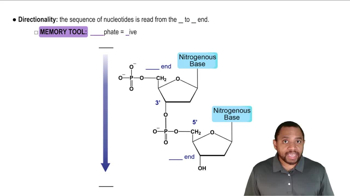
The terms 5' (five prime) and 3' (three prime) refer to the carbon numbers in the DNA's sugar backbone. The 5' end has a phosphate group attached to the fifth carbon, while the 3' end has a hydroxyl group attached to the third carbon. Labeling these ends is important for understanding the directionality of DNA strands and how they interact during processes like replication and transcription.
Recommended video:
Guided course
1:43
Primary Structure of Nucleic Acids Concept 2