Pearson+ LogoPearson+ Logo
Ch.26 Nucleic Acids and Protein Synthesis
McMurry - Fundamentals of GOB 8th Edition
McMurry8th EditionFundamentals of GOBISBN: 9780134015187Not the one you use?Change textbook
Chapter 26, Problem 24a

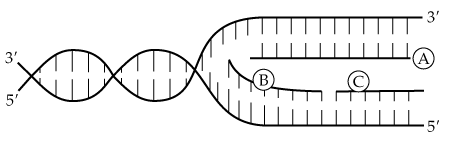
Copy the following simplified drawing of a DNA replication fork:

a. On the drawing, indicate the direction of synthesis of the new strand labeled A and the location of DNA polymerase on the strand.

Verified step by step guidance
1
Understand the structure of a DNA replication fork: A replication fork is the Y-shaped region where the DNA double helix is unwound to allow replication. It consists of a leading strand (synthesized continuously) and a lagging strand (synthesized in fragments).
Identify the direction of DNA synthesis: DNA polymerase synthesizes new DNA strands in the 5' to 3' direction. This means that the new strand labeled A will be synthesized in the 5' to 3' direction relative to its template strand.
Determine the location of DNA polymerase: DNA polymerase is the enzyme responsible for adding nucleotides to the growing DNA strand. On the leading strand, it moves continuously toward the replication fork, while on the lagging strand, it synthesizes short Okazaki fragments away from the fork.
Label the direction of synthesis on the drawing: On the strand labeled A, mark the 5' and 3' ends of the new strand and draw an arrow indicating the direction of synthesis (5' to 3').
Indicate the position of DNA polymerase: On the drawing, place DNA polymerase at the point where it is actively adding nucleotides to the new strand labeled A, ensuring it aligns with the 5' to 3' synthesis direction.

Verified video answer for a similar problem:

This video solution was recommended by our tutors as helpful for the problem above.
Video duration:
6m
Was this helpful?

Key Concepts

Here are the essential concepts you must grasp in order to answer the question correctly.

DNA Replication Fork

The DNA replication fork is a Y-shaped structure that forms during DNA replication, where the double helix unwinds and separates into two single strands. This fork is crucial for the synthesis of new DNA strands, as it provides the template for the replication process. Understanding the orientation of the fork is essential for identifying the direction of strand synthesis.
Recommended video:
Guided course
1:40
Intro to DNA Replication Example 2

Direction of Synthesis

DNA synthesis occurs in a specific direction, from the 5' to the 3' end of the new strand. This means that nucleotides are added to the 3' end of the growing strand, which is critical for the proper replication of DNA. Recognizing this directionality helps in determining how new strands are formed at the replication fork.
Recommended video:
Guided course
1:54
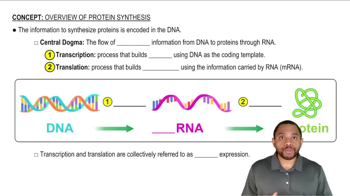
Overview of Protein Synthesis Concept 1

DNA Polymerase

DNA polymerase is the enzyme responsible for synthesizing new DNA strands by adding nucleotides complementary to the template strand. It plays a vital role at the replication fork, where it binds to the template strand and catalyzes the formation of the new strand. Understanding the function and location of DNA polymerase is key to grasping the mechanics of DNA replication.
Recommended video:
Guided course
1:31
Steps of DNA Replication Example 1