Pearson+ LogoPearson+ Logo
Ch.18 Amino Acids and Proteins
McMurry - Fundamentals of GOB 8th Edition
McMurry8th EditionFundamentals of GOBISBN: 9780134015187Not the one you use?Change textbook
Chapter 18, Problem 86a

How do the following noncovalent interactions help to stabilize the tertiary and quaternary structure of a protein? Give an example of a pair of amino acids that could give rise to each interaction.
a. Hydrophobic interactions

Verified step by step guidance
1
Understand the concept of hydrophobic interactions: These occur when nonpolar (hydrophobic) side chains of amino acids cluster together to avoid contact with water. This minimizes the disruption of hydrogen bonding in the surrounding aqueous environment, stabilizing the protein structure.
Recognize the role of hydrophobic interactions in protein folding: In the tertiary structure, hydrophobic side chains are typically buried in the interior of the protein, away from water, while hydrophilic side chains are exposed on the surface. This arrangement contributes to the overall stability of the protein.
Identify amino acids with nonpolar side chains: Examples of amino acids that participate in hydrophobic interactions include leucine, isoleucine, valine, phenylalanine, and alanine. These amino acids have side chains that are nonpolar and hydrophobic.
Provide an example of a pair of amino acids: A pair such as leucine and valine could interact through hydrophobic interactions. Their nonpolar side chains would cluster together in the protein's interior to avoid water.
Relate hydrophobic interactions to protein structure: These interactions help stabilize the tertiary structure by driving the folding process, ensuring that the protein adopts a functional three-dimensional shape. In quaternary structures, hydrophobic interactions can also stabilize the association between different protein subunits.

Verified video answer for a similar problem:

This video solution was recommended by our tutors as helpful for the problem above.
Was this helpful?

Key Concepts

Here are the essential concepts you must grasp in order to answer the question correctly.

Hydrophobic Interactions

Hydrophobic interactions occur when nonpolar amino acids aggregate to avoid contact with water, which stabilizes protein structures. This phenomenon is crucial in the folding of proteins, as it drives the formation of a hydrophobic core, minimizing the exposure of hydrophobic side chains to the aqueous environment. An example of amino acids involved in this interaction is phenylalanine and leucine.
Recommended video:
Guided course
2:41
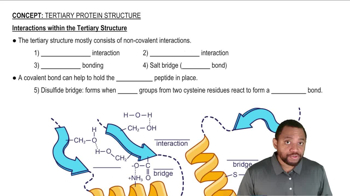
Interactions within the Tertiary Structure Concept 2

Tertiary Structure

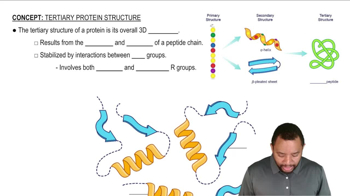
The tertiary structure of a protein refers to its three-dimensional shape formed by the folding of the polypeptide chain. This structure is stabilized by various interactions, including hydrophobic interactions, hydrogen bonds, ionic bonds, and disulfide bridges. The specific arrangement of amino acids in the tertiary structure is critical for the protein's functionality.
Recommended video:
Guided course
2:07
Tertiary Protein Structure Concept 1

Quaternary Structure

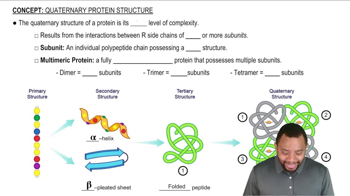
Quaternary structure refers to the assembly of multiple polypeptide chains into a single functional protein complex. This structure is stabilized by noncovalent interactions, such as hydrophobic interactions and hydrogen bonds, between the different subunits. An example of quaternary structure is hemoglobin, which consists of four polypeptide chains that work together to transport oxygen.
Recommended video:
Guided course
3:26
Quaternary Protein Structure Concept 1