Pearson+ LogoPearson+ Logo
Ch.24 Lipid Metabolism
McMurry - Fundamentals of GOB 8th Edition
McMurry8th EditionFundamentals of GOBISBN: 9780134015187Not the one you use?Change textbook
Chapter 24, Problem 60

How many rounds of the lipogenesis cycle are needed to synthesize stearic acid, C17H35COOH?

Verified step by step guidance
1
Understand the problem: Lipogenesis is the process by which fatty acids are synthesized. Each round of the lipogenesis cycle adds a two-carbon unit to the growing fatty acid chain. Stearic acid (C17H35COOH) is a saturated fatty acid with 18 carbon atoms in total.
Determine the starting molecule: The lipogenesis cycle begins with acetyl-CoA, which contributes two carbons in the first step. Malonyl-CoA is then used in subsequent cycles to add two-carbon units.
Calculate the total number of carbons in stearic acid: Stearic acid has 18 carbons (17 from the hydrocarbon chain and 1 from the carboxylic acid group).
Account for the first two carbons: The first two carbons are provided by acetyl-CoA in the initial step of the cycle. This leaves 16 carbons to be added through subsequent rounds of the cycle.
Divide the remaining carbons by 2: Since each round of the lipogenesis cycle adds two carbons, divide the remaining 16 carbons by 2 to determine the number of additional rounds required. Add 1 for the initial step to get the total number of rounds.

Verified video answer for a similar problem:

This video solution was recommended by our tutors as helpful for the problem above.
Video duration:
2m
Was this helpful?

Key Concepts

Here are the essential concepts you must grasp in order to answer the question correctly.

Lipogenesis

Lipogenesis is the metabolic process through which fatty acids are synthesized from acetyl-CoA and other substrates. This process primarily occurs in the liver and adipose tissue and involves a series of enzymatic reactions that convert excess carbohydrates into fatty acids, which can then be stored as triglycerides.

Fatty Acid Synthesis

Fatty acid synthesis involves multiple cycles of the lipogenesis pathway, where each cycle elongates the fatty acid chain by two carbon atoms. The process begins with acetyl-CoA and requires NADPH as a reducing agent, with the final product being a saturated fatty acid, such as stearic acid, which has 18 carbon atoms.
Recommended video:
Guided course
2:00
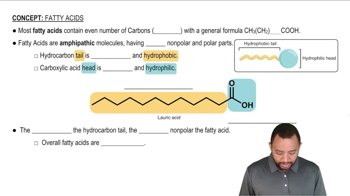
Fatty Acids Concept 1

Stearic Acid

Stearic acid is a long-chain saturated fatty acid with the chemical formula C18H36O2. It is produced through the lipogenesis cycle and is important for various biological functions, including energy storage and membrane structure. To synthesize stearic acid, multiple rounds of the lipogenesis cycle are required, specifically 9 cycles, as each cycle adds two carbon atoms to the growing fatty acid chain.
Recommended video:
Guided course
1:50
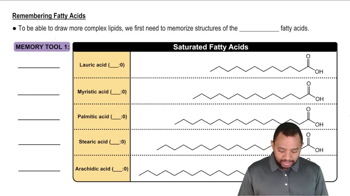
Fatty Acids Concept 5