Pearson+ LogoPearson+ Logo
Ch.24 Lipid Metabolism
McMurry - Fundamentals of GOB 8th Edition
McMurry8th EditionFundamentals of GOBISBN: 9780134015187Not the one you use?Change textbook
Chapter 24, Problem 64

Consuming too many carbohydrates causes deposition of fats in adipose tissue. How does this happen?

Verified step by step guidance
1
Carbohydrates consumed in excess are broken down into glucose during digestion. This glucose enters the bloodstream, increasing blood sugar levels.
The pancreas responds to elevated blood sugar levels by releasing insulin, a hormone that facilitates the uptake of glucose into cells for energy or storage.
When the energy needs of the body are met, excess glucose is converted into glycogen and stored in the liver and muscles. However, the storage capacity for glycogen is limited.
Once glycogen storage is full, any additional glucose is converted into fatty acids through a process called lipogenesis. These fatty acids are then assembled into triglycerides.
Triglycerides are transported to adipose tissue, where they are stored as fat, leading to the deposition of fats in the body when carbohydrate intake exceeds energy expenditure.

Verified video answer for a similar problem:

This video solution was recommended by our tutors as helpful for the problem above.
Video duration:
1m
Was this helpful?

Key Concepts

Here are the essential concepts you must grasp in order to answer the question correctly.

Carbohydrate Metabolism

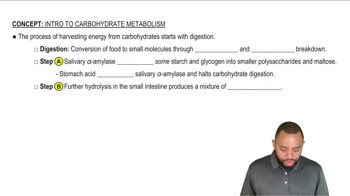
Carbohydrate metabolism refers to the biochemical processes that convert carbohydrates into energy. When carbohydrates are consumed, they are broken down into glucose, which is used for immediate energy or stored as glycogen in the liver and muscles. If carbohydrate intake exceeds the body's energy needs, the excess glucose is converted into fatty acids through a process called lipogenesis.
Recommended video:
Guided course
1:53
Intro To Carbohydrate Metabolism Concept 1

Lipogenesis

Lipogenesis is the metabolic process through which excess carbohydrates are converted into fat for storage. This occurs primarily in the liver and adipose tissue when there is an abundance of glucose. The fatty acids produced are then combined with glycerol to form triglycerides, which are stored in adipose tissue, leading to increased fat deposition.

Adipose Tissue Function

Adipose tissue is a type of connective tissue that stores energy in the form of fat and plays a crucial role in regulating metabolism. It serves as an energy reserve, insulates the body, and protects vital organs. When excess carbohydrates are converted to fat, adipose tissue expands, leading to increased fat storage and potential weight gain.
Recommended video:
Guided course
02:16
Logarithmic Functions