Pearson+ LogoPearson+ Logo
Ch.24 Lipid Metabolism
McMurry - Fundamentals of GOB 8th Edition
McMurry8th EditionFundamentals of GOBISBN: 9780134015187Not the one you use?Change textbook
Chapter 24, Problem 65

Why are extra calories consumed as carbohydrates stored as fat and not as glycogen?

Verified step by step guidance
1
Understand the storage forms of energy in the body: The body stores energy primarily in two forms—glycogen and fat. Glycogen is a polysaccharide stored in the liver and muscles, while fat is stored in adipose tissue as triglycerides.
Recognize the storage capacity of glycogen: Glycogen storage is limited. The liver can store approximately 100-120 grams of glycogen, and muscles can store around 300-400 grams. Once these storage limits are reached, excess carbohydrates cannot be stored as glycogen.
Learn about the conversion of carbohydrates to fat: When glycogen stores are full, excess carbohydrates are converted into fat through a process called lipogenesis. This involves the conversion of glucose into acetyl-CoA, which is then used to synthesize fatty acids. These fatty acids are stored as triglycerides in adipose tissue.
Understand the efficiency of fat storage: Fat is a more efficient long-term energy storage molecule because it is more energy-dense (9 kcal/g compared to 4 kcal/g for carbohydrates) and does not require water for storage, unlike glycogen. This makes fat a preferred storage form for excess calories.
Connect the biological purpose: The body prioritizes fat storage for long-term energy needs and survival during periods of caloric deficit or fasting. Glycogen, on the other hand, is reserved for short-term energy demands, such as physical activity or maintaining blood glucose levels.

Verified video answer for a similar problem:

This video solution was recommended by our tutors as helpful for the problem above.
Video duration:
1m
Was this helpful?

Key Concepts

Here are the essential concepts you must grasp in order to answer the question correctly.

Carbohydrate Metabolism

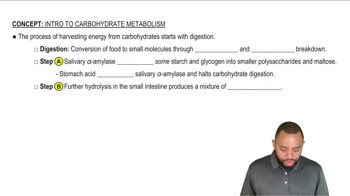
Carbohydrate metabolism refers to the biochemical processes that convert carbohydrates into energy. When carbohydrates are consumed, they are broken down into glucose, which can be used immediately for energy or stored for later use. The body primarily stores glucose as glycogen in the liver and muscles, but there is a limit to how much glycogen can be stored.
Recommended video:
Guided course
1:53
Intro To Carbohydrate Metabolism Concept 1

Glycogen Storage Capacity

Glycogen storage capacity is the maximum amount of glycogen that can be stored in the body, primarily in the liver and muscle tissues. This capacity is limited, typically around 100 grams in the liver and 300-400 grams in muscles for an average adult. Once glycogen stores are full, any excess glucose from carbohydrate consumption is converted into fat through a process called lipogenesis.
Recommended video:
Guided course
02:19
Heat Capacity

Lipogenesis

Lipogenesis is the metabolic process through which excess carbohydrates (and other macronutrients) are converted into fatty acids and subsequently stored as fat in adipose tissue. This process occurs when the body's energy needs are met, and there is an excess of calories, leading to the storage of energy in a more compact form, which is fat, rather than glycogen.