Pearson+ LogoPearson+ Logo
Ch.15 Aldehydes and Ketones
McMurry - Fundamentals of GOB 8th Edition
McMurry8th EditionFundamentals of GOBISBN: 9780134015187Not the one you use?Change textbook
Chapter 15, Problem 44

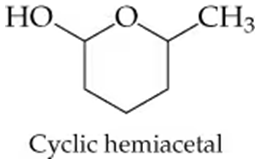
Cyclic hemiacetals commonly form if a molecule has both an alcohol group and a carbonyl group elsewhere in the same molecule, especially if they are four or five carbons apart. What is the structure of the hydroxy aldehyde from which this hemiacetal might form? 

Verified step by step guidance
1
Identify the functional groups in the molecule: A cyclic hemiacetal forms when a molecule contains both an alcohol (-OH) group and a carbonyl group (C=O, such as an aldehyde or ketone) within the same structure.
Determine the spatial relationship between the alcohol and carbonyl groups: For a stable cyclic hemiacetal to form, the alcohol group and the carbonyl group should be separated by four or five carbon atoms, allowing the molecule to form a five- or six-membered ring.
Analyze the reaction mechanism: The oxygen atom in the alcohol group acts as a nucleophile, attacking the electrophilic carbon atom in the carbonyl group. This results in the formation of a new C-O bond and the conversion of the carbonyl group into a hydroxyl group (-OH).
Draw the hydroxy aldehyde structure: To deduce the structure of the hydroxy aldehyde, place the aldehyde group (R-CHO) at one end of the molecule and the alcohol group (-OH) four or five carbons away. Ensure the chain length and connectivity allow for ring closure.
Verify the cyclic hemiacetal formation: Check that the resulting structure can form a stable five- or six-membered ring by connecting the oxygen atom of the alcohol group to the carbon atom of the aldehyde group, completing the hemiacetal structure.

Verified video answer for a similar problem:

This video solution was recommended by our tutors as helpful for the problem above.
Was this helpful?

Key Concepts

Here are the essential concepts you must grasp in order to answer the question correctly.

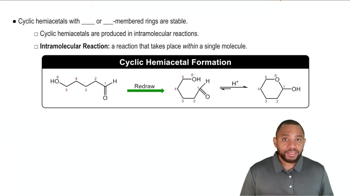
Cyclic Hemiacetals

Cyclic hemiacetals are formed when an alcohol group reacts with a carbonyl group (aldehyde or ketone) within the same molecule, resulting in a ring structure. This reaction typically occurs in sugars and other organic compounds, where the hydroxyl group attacks the carbonyl carbon, leading to a stable cyclic form. The formation of cyclic hemiacetals is crucial in carbohydrate chemistry, influencing the properties and reactivity of sugars.
Recommended video:
Guided course
2:55
Cyclic Hemiacetals Concept 2

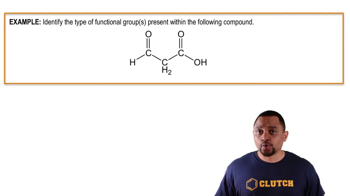
Carbonyl Group

The carbonyl group is a functional group characterized by a carbon atom double-bonded to an oxygen atom (C=O). It is a key feature in aldehydes and ketones, influencing their chemical behavior. In the context of hemiacetal formation, the carbonyl group serves as the reactive site that interacts with the alcohol group, facilitating the cyclization process that leads to the formation of cyclic structures.
Recommended video:
Guided course
1:00
Functional Groups with Carbonyls Example 3

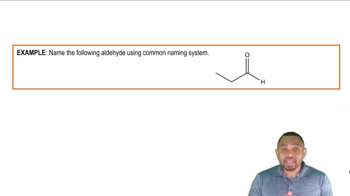
Hydroxy Aldehyde

A hydroxy aldehyde is an organic compound that contains both a hydroxyl group (-OH) and an aldehyde group (-CHO) within the same molecule. This structure is significant because it can participate in the formation of cyclic hemiacetals when the hydroxyl group reacts with the carbonyl carbon of the aldehyde. Understanding the structure of hydroxy aldehydes is essential for predicting their reactivity and the types of cyclic compounds they can form.
Recommended video:
Guided course
0:34
Naming Aldehydes Example 2