Pearson+ LogoPearson+ Logo
Ch.15 Aldehydes and Ketones
McMurry - Fundamentals of GOB 8th Edition
McMurry8th EditionFundamentals of GOBISBN: 9780134015187Not the one you use?Change textbook
Chapter 15, Problem 47b

Acetals and ketals are usually made by reaction of an aldehyde or ketone with two molecules of a monoalcohol. If an aldehyde or ketone reacts with one molecule of a dialcohol, however, a cyclic acetal or ketal results.
b. Draw the cyclic ketal formed when the hemiketal from part (a) reacts with the ―OH labeled in blue.

Verified step by step guidance
1
Identify the functional groups in the starting material. In this case, the starting material is a hemiketal, which contains both an alcohol (-OH) group and an ether (-OR) group attached to the same carbon atom.
Recognize that the reaction involves a dialcohol (a molecule with two -OH groups) and that one of these -OH groups is labeled in blue. The reaction will form a cyclic ketal by replacing the -OH group of the hemiketal with a bond to the dialcohol.
Understand the mechanism: The -OH group of the hemiketal reacts with the -OH group of the dialcohol in a condensation reaction, releasing a molecule of water (H₂O). This forms a new ether bond between the hemiketal and the dialcohol.
Determine the structure of the cyclic ketal: The dialcohol forms a ring by connecting its two -OH groups to the carbon atom of the hemiketal. The size of the ring depends on the number of carbon atoms in the dialcohol chain.
Draw the final cyclic ketal structure: Ensure that the carbon atom originally part of the hemiketal is now part of the ring, with two ether (-OR) groups attached to it. Verify that the labeled -OH group in blue is part of the new ether bond in the cyclic structure.

Verified video answer for a similar problem:

This video solution was recommended by our tutors as helpful for the problem above.
Was this helpful?

Key Concepts

Here are the essential concepts you must grasp in order to answer the question correctly.

Acetals and Ketals

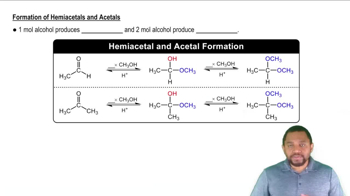
Acetals and ketals are functional groups formed from the reaction of aldehydes or ketones with alcohols. An acetal is derived from an aldehyde, while a ketal comes from a ketone. The reaction typically involves the nucleophilic attack of the alcohol on the carbonyl carbon, leading to the formation of a hemiacetal or hemiketal intermediate before the final acetal or ketal is formed.
Recommended video:
Guided course
2:17
Formation of Hemiacetals and Acetals Concept 2

Cyclic Acetals and Ketals

Cyclic acetals and ketals are formed when a dialcohol reacts with an aldehyde or ketone, resulting in a ring structure. This reaction involves the formation of a five- or six-membered ring, which stabilizes the molecule. The cyclic structure is significant in organic chemistry as it can influence the reactivity and properties of the compound, making it more resistant to hydrolysis compared to its acyclic counterparts.
Recommended video:
Guided course
2:17
Formation of Hemiacetals and Acetals Concept 2

Hemiketal Formation

A hemiketal is an intermediate compound formed when a ketone reacts with one molecule of alcohol. It contains both an alcohol and a carbonyl group, making it a key step in the synthesis of ketals. Understanding hemiketal formation is crucial for predicting the outcome of subsequent reactions, such as the formation of cyclic ketals when a hemiketal reacts with another alcohol.
Recommended video:
Guided course
1:41
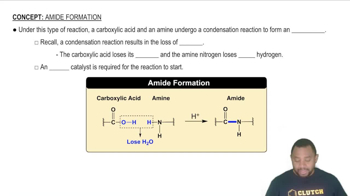
Amide Formation Concept 1