Write structural formulas for compounds that meet the following descriptions: b. An alkene with a chemical formula of C10H12, that has cis–trans isomers and contains a benzene ring.
Verified step by step guidance
1
Step 1: Begin by analyzing the chemical formula C10H12. This formula indicates the compound contains 10 carbon atoms and 12 hydrogen atoms. Since the problem specifies an alkene, the compound must include at least one double bond.
Step 2: Recognize that the compound contains a benzene ring. A benzene ring is an aromatic structure with six carbon atoms arranged in a hexagonal ring, alternating single and double bonds. This accounts for six of the carbon atoms and four of the hydrogen atoms (C6H4).
Step 3: Determine the remaining atoms. After accounting for the benzene ring, there are four carbon atoms and eight hydrogen atoms left (C4H8). These must form an alkene structure with a double bond.
Step 4: Ensure the alkene structure allows for cis-trans isomerism. Cis-trans isomerism occurs when there are two different groups attached to each carbon of the double bond. Arrange the remaining C4H8 as a straight-chain or branched alkene that satisfies this condition.
Step 5: Combine the benzene ring and the alkene structure into a single molecule. Attach the alkene group to the benzene ring in a way that maintains the chemical formula C10H12 and allows for cis-trans isomerism. Draw the structural formulas for both the cis and trans isomers.
Verified video answer for a similar problem:
This video solution was recommended by our tutors as helpful for the problem above
Play a video:
Was this helpful?
Key Concepts
Here are the essential concepts you must grasp in order to answer the question correctly.
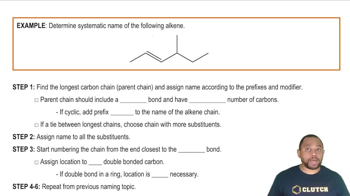
Alkenes
Alkenes are hydrocarbons that contain at least one carbon-carbon double bond (C=C). They are unsaturated compounds, meaning they have fewer hydrogen atoms than alkanes with the same number of carbon atoms. The presence of a double bond allows for geometric isomerism, including cis-trans isomers, which occur due to restricted rotation around the double bond.
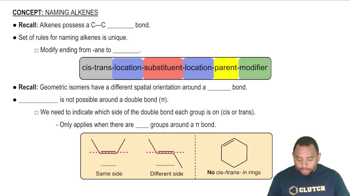
Cis-trans isomerism is a type of stereoisomerism where the spatial arrangement of groups around a double bond differs. In cis isomers, similar groups are on the same side of the double bond, while in trans isomers, they are on opposite sides. This phenomenon is significant in alkenes, especially when they are substituted with different groups, as it can affect the physical and chemical properties of the compounds.
A benzene ring is a cyclic structure composed of six carbon atoms, with alternating double bonds, resulting in a stable aromatic compound. The presence of a benzene ring in a compound can influence its reactivity and stability. In the context of alkenes, a benzene ring can provide additional sites for substitution and can affect the overall geometry and isomerism of the molecule.