Pearson+ LogoPearson+ Logo
Ch.13 Alkenes, Alkynes, and Aromatic Compounds
McMurry - Fundamentals of GOB 8th Edition
McMurry8th EditionFundamentals of GOBISBN: 9780134015187Not the one you use?Change textbook
Chapter 13, Problem 34b

Write structural formulas for compounds that meet the following descriptions:
b. An alkyne with 5 carbons total (three possibilities)

Verified step by step guidance
1
Step 1: Recall that an alkyne is a hydrocarbon containing at least one triple bond between two carbon atoms. The general formula for alkynes is CₙH₂ₙ₋₂.
Step 2: Since the compound must have 5 carbons, start by arranging the carbon atoms in a chain. The simplest structure is a straight chain with the triple bond between two carbons. For example, place the triple bond between the first and second carbons.
Step 3: Consider alternative positions for the triple bond. Move the triple bond to other locations in the chain, such as between the second and third carbons or between the third and fourth carbons. Ensure the total number of carbons remains 5.
Step 4: Explore branching possibilities. For example, create a structure where the main chain has 4 carbons, and the fifth carbon is attached as a branch. Place the triple bond in the main chain while maintaining the correct number of hydrogens.
Step 5: Verify that each structure adheres to the rules of chemical bonding (each carbon must have 4 bonds total) and satisfies the alkyne formula C₅H₈. Write the structural formulas for each possibility using condensed or expanded notation.

Verified video answer for a similar problem:

This video solution was recommended by our tutors as helpful for the problem above.
Was this helpful?

Key Concepts

Here are the essential concepts you must grasp in order to answer the question correctly.

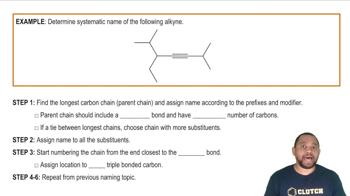
Alkynes

Alkynes are hydrocarbons that contain at least one carbon-carbon triple bond. They are unsaturated compounds and follow the general formula CnH2n-2, where 'n' is the number of carbon atoms. The presence of the triple bond gives alkynes unique chemical properties, making them more reactive than alkenes and alkanes.
Recommended video:
Guided course
4:11
Naming Alkynes Example 1

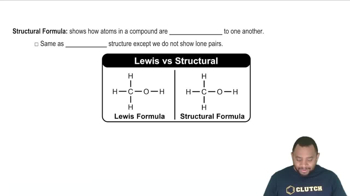
Structural Formulas

Structural formulas represent the arrangement of atoms within a molecule, showing how the atoms are bonded to each other. They can be drawn in various ways, including Lewis structures, condensed formulas, or skeletal structures. Understanding structural formulas is essential for visualizing molecular geometry and predicting reactivity.
Recommended video:
Guided course
1:01
Structural Formula Concept 2

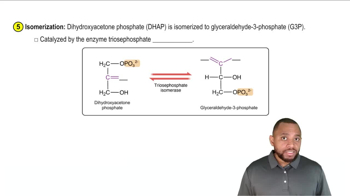
Isomerism

Isomerism refers to the phenomenon where compounds with the same molecular formula can have different structural arrangements. In the case of a five-carbon alkyne, there can be multiple structural isomers, such as different positions of the triple bond or variations in branching. Recognizing isomers is crucial for understanding the diversity of organic compounds.
Recommended video:
Guided course
1:26
Glycolysis Concept 5