Draw structures corresponding to the following IUPAC names: a. trans-2-Pentene b. trans-3,4-Dimethyl-3-hexene c. 2-Methyl-1,3-butadiene d. trans-3-Heptene
Verified step by step guidance
1
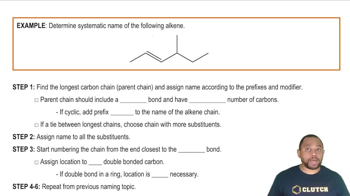
Step 1: Understand the IUPAC naming conventions for alkenes. The name provides information about the number of carbon atoms in the chain, the position of the double bond, and the substituents. The 'trans' prefix indicates that the substituents on either side of the double bond are on opposite sides.
Step 2: For trans-2-Pentene, draw a five-carbon chain with a double bond between the second and third carbons. Ensure the substituents on the double bond are on opposite sides to reflect the 'trans' configuration.
Step 3: For trans-3,4-Dimethyl-3-hexene, draw a six-carbon chain with a double bond between the third and fourth carbons. Add methyl groups to the third and fourth carbons, ensuring the substituents on the double bond are on opposite sides to reflect the 'trans' configuration.
Step 4: For 2-Methyl-1,3-butadiene, draw a four-carbon chain with two double bonds: one between the first and second carbons, and another between the third and fourth carbons. Add a methyl group to the second carbon.
Step 5: For trans-3-Heptene, draw a seven-carbon chain with a double bond between the third and fourth carbons. Ensure the substituents on the double bond are on opposite sides to reflect the 'trans' configuration.
Verified video answer for a similar problem:
This video solution was recommended by our tutors as helpful for the problem above.
Play a video:
Was this helpful?
Key Concepts
Here are the essential concepts you must grasp in order to answer the question correctly.
IUPAC Nomenclature
IUPAC nomenclature is a systematic method for naming organic chemical compounds. It provides a set of rules to create unique names based on the structure of the molecule, including the longest carbon chain, functional groups, and stereochemistry. Understanding these rules is essential for accurately interpreting and drawing chemical structures from given names.
Stereochemistry refers to the study of the spatial arrangement of atoms in molecules and how this affects their chemical properties. In the context of the question, terms like 'trans' indicate specific geometric isomers where substituents are positioned on opposite sides of a double bond. Recognizing these configurations is crucial for accurately representing the structures of the compounds.
Alkenes are hydrocarbons that contain at least one carbon-carbon double bond, which significantly influences their reactivity and physical properties. The position of the double bond and the presence of substituents, such as methyl groups, determine the specific structure of the alkene. Familiarity with drawing alkenes, including their cis/trans isomers, is necessary for completing the task of sketching the structures from the IUPAC names.