Pearson+ LogoPearson+ Logo
Ch.13 Alkenes, Alkynes, and Aromatic Compounds
McMurry - Fundamentals of GOB 8th Edition
McMurry8th EditionFundamentals of GOBISBN: 9780134015187Not the one you use?Change textbook
Chapter 13, Problem 35a

Write structural formulas for compounds that meet the following descriptions:
a. An alkene, C6H12, that cannot have cis–trans isomers and whose longest chain is 5 carbons long

Verified step by step guidance
1
Step 1: Understand the requirements of the problem. The compound is an alkene (contains a carbon-carbon double bond) with the molecular formula C6H12. It cannot have cis-trans isomers, which means the double bond must be located in such a way that identical groups are attached to the same carbon atom of the double bond.
Step 2: Recall that cis-trans isomerism occurs when the two carbons in the double bond each have two different groups attached. To prevent cis-trans isomerism, ensure that one of the carbons in the double bond has two identical groups attached.
Step 3: Consider the structural requirement that the longest chain is 5 carbons long. This means the main chain of the molecule should have 5 carbons, and the sixth carbon will be part of a substituent group.
Step 4: Draw the structure of the compound. Start with a 5-carbon chain and place the double bond in a position where one of the carbons in the double bond has two identical groups (e.g., two hydrogens). Add the sixth carbon as a substituent group to complete the molecular formula C6H12.
Step 5: Verify the structure. Ensure the molecular formula matches C6H12, the compound is an alkene, the longest chain is 5 carbons, and the double bond does not allow for cis-trans isomerism. Adjust the structure if necessary to meet all criteria.

Verified video answer for a similar problem:

This video solution was recommended by our tutors as helpful for the problem above.
Was this helpful?

Key Concepts

Here are the essential concepts you must grasp in order to answer the question correctly.

Alkene

An alkene is a type of hydrocarbon that contains at least one carbon-carbon double bond (C=C). Alkenes are unsaturated compounds, meaning they have fewer hydrogen atoms than alkanes with the same number of carbon atoms. The presence of the double bond gives alkenes unique chemical properties and reactivity, making them important in organic chemistry.
Recommended video:
Guided course
3:26
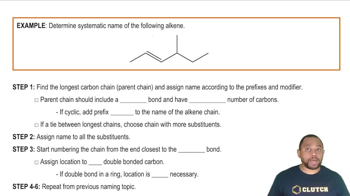
Naming Alkenes Example 1

Cis-Trans Isomerism

Cis-trans isomerism, also known as geometric isomerism, occurs in alkenes due to the restricted rotation around the double bond. In cis isomers, substituents are on the same side of the double bond, while in trans isomers, they are on opposite sides. For a compound to exhibit cis-trans isomerism, it must have two different substituents on each carbon of the double bond, which is not possible in certain structures.
Recommended video:
Guided course
2:47
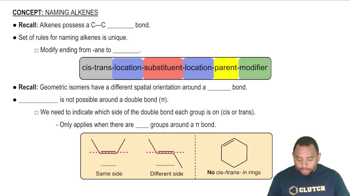
Rules for Naming Alkenes Concept 1

Longest Carbon Chain

The longest carbon chain in a hydrocarbon is the continuous chain of carbon atoms that contains the most carbon atoms. Identifying the longest chain is crucial for naming the compound according to IUPAC nomenclature and determining its structural features. In the context of alkenes, the longest chain also influences the position of the double bond and the potential for isomerism.
Recommended video:
Guided course
1:43
Intro to Electron Transport Chain Example 1