Pearson+ LogoPearson+ Logo
Ch.13 Alkenes, Alkynes, and Aromatic Compounds
McMurry - Fundamentals of GOB 8th Edition
McMurry8th EditionFundamentals of GOBISBN: 9780134015187Not the one you use?Change textbook
Chapter 13, Problem 70a,b

The following names are incorrect by IUPAC rules. Draw the structures represented by the following names, and write their correct names. Label each as being symmetrically or unsymmetrically substituted.
a. 2-Methyl-4-hexene
b. 1,3-Dimethyl-1-hexyne

Verified step by step guidance
1
Step 1: Understand the problem. The task is to identify the errors in the given names according to IUPAC nomenclature rules, draw the structures based on the incorrect names, and then rename them correctly. Additionally, determine whether the compounds are symmetrically or unsymmetrically substituted.
Step 2: Analyze the first compound, '2-Methyl-4-hexene.' According to IUPAC rules, the parent chain should be the longest continuous chain containing the double bond. Number the chain such that the double bond gets the lowest possible number. Draw the structure based on the given name, ensuring the double bond is at position 4 and a methyl group is at position 2.
Step 3: Correct the name for '2-Methyl-4-hexene.' Check the numbering of the chain to ensure the double bond has the lowest possible number. If necessary, rename the compound by reassigning the position of the double bond and substituents. Determine if the substituents are symmetrically or unsymmetrically distributed.
Step 4: Analyze the second compound, '1,3-Dimethyl-1-hexyne.' According to IUPAC rules, the parent chain should be the longest continuous chain containing the triple bond. Number the chain such that the triple bond gets the lowest possible number. Draw the structure based on the given name, ensuring the triple bond is at position 1 and methyl groups are at positions 1 and 3.
Step 5: Correct the name for '1,3-Dimethyl-1-hexyne.' Check the numbering of the chain to ensure the triple bond has the lowest possible number. If necessary, rename the compound by reassigning the position of the triple bond and substituents. Determine if the substituents are symmetrically or unsymmetrically distributed.

Verified video answer for a similar problem:

This video solution was recommended by our tutors as helpful for the problem above.
Was this helpful?

Key Concepts

Here are the essential concepts you must grasp in order to answer the question correctly.

IUPAC Nomenclature

IUPAC nomenclature is a systematic method for naming chemical compounds, ensuring that each name conveys specific information about the structure of the molecule. It includes rules for identifying the longest carbon chain, the position of functional groups, and the correct use of prefixes and suffixes. Understanding these rules is essential for accurately interpreting and correcting the names provided in the question.
Recommended video:
Guided course
3:18
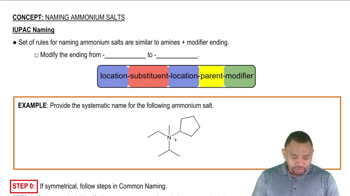
IUPAC Naming Concept 3

Structural Representation

Structural representation involves drawing the molecular structure of a compound based on its name. This includes depicting the arrangement of atoms, bonds, and any functional groups. For the names given, one must visualize and sketch the correct structures to identify any discrepancies in the original names and to determine whether they are symmetrically or unsymmetrically substituted.
Recommended video:
Guided course
2:08
Molecular Representations Concept 1

Substitution Patterns

Substitution patterns refer to the arrangement of substituents on a carbon chain, which can be classified as symmetrical or unsymmetrical. Symmetrical substitution means that substituents are arranged evenly around the central carbon chain, while unsymmetrical substitution indicates an uneven distribution. Recognizing these patterns is crucial for labeling the structures correctly after drawing them.
Recommended video:
Guided course
5:07
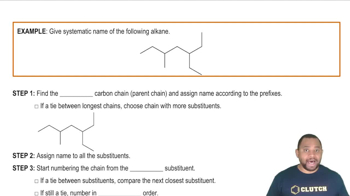
Naming Alkanes with Substituents Example 1