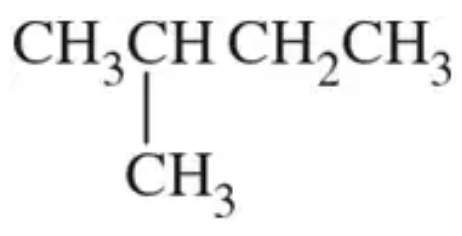
Convert the condensed structures shown to skeletal structures. (a)
Verified step by step guidance
1
Identify the condensed structure provided in the problem. Condensed structures represent molecules in a compact form, showing the connectivity of atoms without explicitly drawing bonds.
Understand the skeletal structure format. In skeletal structures, carbon atoms are represented as vertices or endpoints of lines, and hydrogen atoms bonded to carbons are implied rather than explicitly shown.
Analyze the condensed structure to determine the arrangement of carbon atoms and any functional groups or substituents. Pay attention to branching and double or triple bonds if present.
Draw the skeletal structure by placing carbon atoms as vertices and connecting them with lines to represent bonds. Add any functional groups explicitly, such as -OH, -Cl, or =O, while omitting hydrogens bonded to carbons.
Double-check the skeletal structure to ensure it accurately represents the connectivity and bonding of the original condensed structure, including the correct number of bonds for each carbon atom.
Verified video answer for a similar problem:
This video solution was recommended by our tutors as helpful for the problem above
Video duration:
2m
Play a video:
Was this helpful?
Key Concepts
Here are the essential concepts you must grasp in order to answer the question correctly.
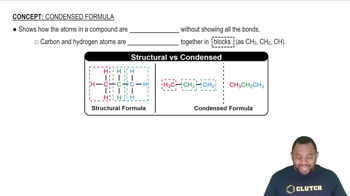
Condensed Structures
Condensed structures are a simplified way of representing molecular structures that show the connectivity of atoms without depicting all the bonds explicitly. They often use shorthand notation to indicate functional groups and the arrangement of atoms, making it easier to visualize complex molecules. Understanding condensed structures is essential for converting them into skeletal structures.
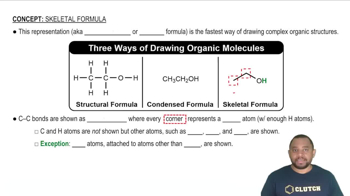
Skeletal structures, also known as line-angle formulas, represent organic molecules by showing only the bonds between carbon atoms as lines, with vertices representing carbon atoms. Hydrogen atoms attached to carbons are usually omitted for simplicity. This representation is crucial for visualizing the overall shape and connectivity of the molecule, which aids in understanding its chemical properties and reactivity.
Functional groups are specific groups of atoms within molecules that are responsible for the characteristic chemical reactions of those molecules. They play a key role in determining the properties and behavior of organic compounds. Recognizing functional groups in condensed structures is vital for accurately converting them to skeletal structures, as they influence the overall structure and reactivity of the molecule.