Pearson+ LogoPearson+ Logo
Ch.10 Proteins Workers of the Cell
Frost - General, Organic and Biological Chemistry 4th Edition
Frost4th EditionGeneral, Organic and Biological ChemistryISBN: 9780134988696Not the one you use?Change textbook
Chapter 6, Problem 86

Do the amino acids that are in the active site of an enzyme have to be near each other in the enzyme’s primary structure? If no, explain.

Verified step by step guidance
1
Understand the primary structure of a protein: The primary structure refers to the linear sequence of amino acids in a polypeptide chain, connected by peptide bonds.
Learn about the active site of an enzyme: The active site is the region of an enzyme where substrate molecules bind and undergo a chemical reaction. It is formed by specific amino acids that interact with the substrate.
Recognize the role of protein folding: Proteins fold into complex three-dimensional structures (secondary, tertiary, and quaternary structures) that bring amino acids from different parts of the primary structure into close proximity.
Understand that amino acids in the active site do not need to be adjacent in the primary structure: Through folding, amino acids that are far apart in the linear sequence can be brought together spatially to form the active site.
Conclude that the spatial arrangement of amino acids in the active site is determined by the enzyme's three-dimensional structure, not their position in the primary structure.

Verified video answer for a similar problem:

This video solution was recommended by our tutors as helpful for the problem above.
Video duration:
3m
Was this helpful?

Key Concepts

Here are the essential concepts you must grasp in order to answer the question correctly.

Enzyme Structure

Enzymes are proteins that consist of long chains of amino acids folded into specific three-dimensional shapes. The primary structure refers to the linear sequence of amino acids, while the secondary and tertiary structures involve the folding and interactions that create the enzyme's active site. Understanding how these structures relate is crucial for grasping enzyme functionality.
Recommended video:
Guided course
2:14
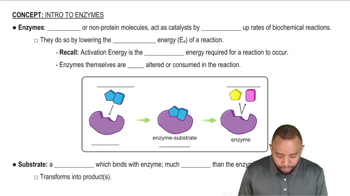
Intro to Enzymes Concept 1

Active Site

The active site of an enzyme is the region where substrate molecules bind and undergo a chemical reaction. It is typically formed by a specific arrangement of amino acids that may not be adjacent in the primary structure but come together in the folded enzyme. This spatial arrangement is essential for the enzyme's catalytic activity.
Recommended video:
Guided course
1:06
Factors Affecting Enzyme Activity Concept 1

Protein Folding

Protein folding is the process by which a linear chain of amino acids acquires its functional three-dimensional shape. This process is driven by various interactions, including hydrogen bonds, hydrophobic interactions, and ionic bonds. The final folded structure determines the enzyme's active site configuration, allowing amino acids that are distant in the primary sequence to be positioned close together in the active site.
Recommended video:
Guided course
1:17
Tertiary Protein Structure Example 1