Pearson+ LogoPearson+ Logo
Ch.10 Proteins Workers of the Cell
Frost - General, Organic and Biological Chemistry 4th Edition
Frost4th EditionGeneral, Organic and Biological ChemistryISBN: 9780134988696Not the one you use?Change textbook
Chapter 6, Problem 44

What is the name given to a small, organic nonprotein part of an enzyme that is involved in catalysis?

Verified step by step guidance
1
Understand that enzymes are biological catalysts that speed up chemical reactions in living organisms.
Recognize that some enzymes require additional components to function properly. These components can be either inorganic ions or organic molecules.
Learn that the organic nonprotein part of an enzyme that assists in catalysis is called a 'coenzyme.'
Coenzymes often work by transferring chemical groups or electrons during the reaction, enabling the enzyme to perform its catalytic function.
Examples of coenzymes include NAD⁺ (nicotinamide adenine dinucleotide) and FAD (flavin adenine dinucleotide), which are involved in redox reactions in metabolism.

Verified video answer for a similar problem:

This video solution was recommended by our tutors as helpful for the problem above.
Video duration:
4m
Was this helpful?

Key Concepts

Here are the essential concepts you must grasp in order to answer the question correctly.

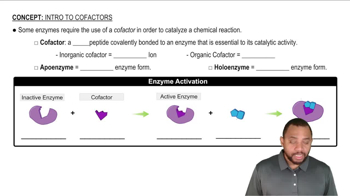
Cofactor

A cofactor is a non-protein chemical compound that is required for the biological activity of a protein, often an enzyme. Cofactors can be metal ions or organic molecules, and they assist in the enzyme's catalytic activity by stabilizing the enzyme-substrate complex or participating directly in the chemical reaction.
Recommended video:
Guided course
2:39
Intro to Cofactors Concept 1

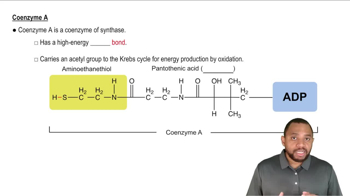
Coenzyme

Coenzymes are a specific type of organic cofactor that are often derived from vitamins. They bind to enzymes and help facilitate the transfer of specific chemical groups during enzymatic reactions, thus playing a crucial role in metabolism and energy production.
Recommended video:
Guided course
1:02
Coenzyme A Concept 4

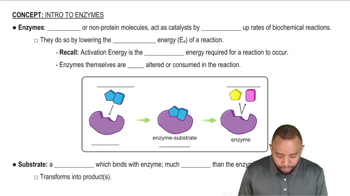
Enzyme Catalysis

Enzyme catalysis refers to the process by which enzymes accelerate chemical reactions in biological systems. Enzymes lower the activation energy required for reactions, allowing them to occur more rapidly and efficiently, which is essential for maintaining life processes.
Recommended video:
Guided course
2:14
Intro to Enzymes Concept 1