Pearson+ LogoPearson+ Logo
Ch.12 Food as Fuel An Overview of Metabolism
Frost - General, Organic and Biological Chemistry 4th Edition
Frost4th EditionGeneral, Organic and Biological ChemistryISBN: 9780134988696Not the one you use?Change textbook
Chapter 8, Problem 55a

Capric acid is a saturated fatty acid, [10:0].
a. Draw fatty acyl capric acid activated for β oxidation.

Verified step by step guidance
1
Understand the structure of capric acid: Capric acid is a saturated fatty acid with the formula C10H20O2. It has 10 carbon atoms and no double bonds (saturated). The carboxylic acid group (-COOH) is at one end of the molecule.
Recall the activation process for β oxidation: Fatty acids are activated by forming a thioester bond with coenzyme A (CoA). This process converts the fatty acid into fatty acyl-CoA, which is the activated form required for β oxidation.
Draw the structure of capric acid: Start with the carboxylic acid group (-COOH) at one end, followed by a chain of 10 carbon atoms. Ensure all carbons are saturated with hydrogen atoms.
Modify the structure to represent fatty acyl-CoA: Replace the -OH group of the carboxylic acid with a thioester bond (-S-CoA). This involves attaching the sulfur atom of CoA to the carbon of the carboxylic acid group.
Label the structure clearly: Indicate the fatty acyl-CoA group and ensure the chain length (10 carbons) is visible. This is the activated form of capric acid ready for β oxidation.

Verified video answer for a similar problem:

This video solution was recommended by our tutors as helpful for the problem above.
Video duration:
1m
Was this helpful?

Key Concepts

Here are the essential concepts you must grasp in order to answer the question correctly.

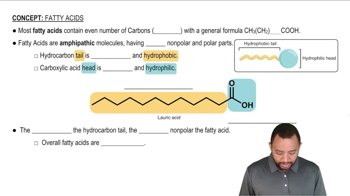
Fatty Acids

Fatty acids are carboxylic acids with long hydrocarbon chains, which can be saturated or unsaturated. Saturated fatty acids, like capric acid, contain no double bonds between carbon atoms, resulting in a straight chain structure. This characteristic influences their physical properties and metabolic pathways, including their activation for β-oxidation.
Recommended video:
Guided course
2:00
Fatty Acids Concept 1

β-Oxidation

β-Oxidation is the metabolic process by which fatty acids are broken down in the mitochondria to generate acetyl-CoA, which can then enter the citric acid cycle for energy production. This process involves the sequential removal of two-carbon units from the fatty acid chain, starting from the carboxyl end, and requires the activation of the fatty acid to acyl-CoA before it can enter the mitochondria.

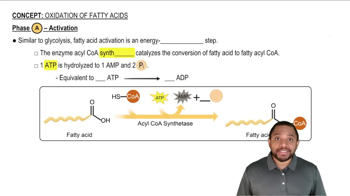
Fatty Acyl-CoA Activation

The activation of fatty acids to fatty acyl-CoA is a crucial step for their metabolism. This process involves the conversion of a fatty acid into its CoA derivative, catalyzed by the enzyme acyl-CoA synthetase. This activation is essential for the fatty acid to be transported into the mitochondria and undergo β-oxidation, making it a key step in fatty acid metabolism.
Recommended video:
Guided course
1:29
Oxidation of Fatty Acids Concept 1