Pearson+ LogoPearson+ Logo
Ch.12 Food as Fuel An Overview of Metabolism
Frost - General, Organic and Biological Chemistry 4th Edition
Frost4th EditionGeneral, Organic and Biological ChemistryISBN: 9780134988696Not the one you use?Change textbook
Chapter 8, Problem 51c

List the energy yield in ATP molecules for each of the following:
c. 2 Pyruvate → 2 acetyl CoA + 2 CO2

Verified step by step guidance
1
Understand the context: The conversion of 2 pyruvate molecules to 2 acetyl CoA molecules involves the pyruvate dehydrogenase complex. This process also produces 2 molecules of CO₂ and generates energy in the form of NADH.
Recall the energy yield: Each pyruvate molecule produces 1 NADH during its conversion to acetyl CoA. Since there are 2 pyruvate molecules, this results in 2 NADH molecules.
Determine the ATP equivalence: NADH molecules are used in the electron transport chain to generate ATP. Each NADH typically yields approximately 2.5 ATP molecules during oxidative phosphorylation.
Calculate the total ATP yield: Multiply the number of NADH molecules (2) by the ATP yield per NADH (2.5). This gives the total ATP yield from the conversion of 2 pyruvate to 2 acetyl CoA.
Summarize the process: The conversion of 2 pyruvate to 2 acetyl CoA yields 2 NADH, which corresponds to approximately 5 ATP molecules when processed through the electron transport chain.

Verified video answer for a similar problem:

This video solution was recommended by our tutors as helpful for the problem above.
Video duration:
2m
Was this helpful?

Key Concepts

Here are the essential concepts you must grasp in order to answer the question correctly.

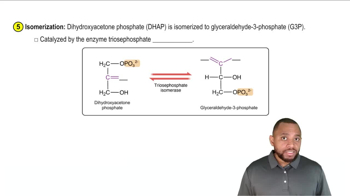
Glycolysis

Glycolysis is the metabolic pathway that converts glucose into pyruvate, yielding a net gain of 2 ATP molecules per glucose molecule. This process occurs in the cytoplasm and is anaerobic, meaning it does not require oxygen. Understanding glycolysis is essential for determining the energy yield from pyruvate conversion.
Recommended video:
Guided course
1:26
Glycolysis Concept 5

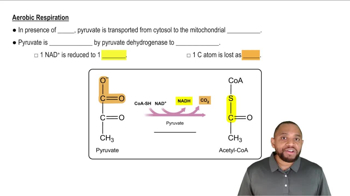
Pyruvate Decarboxylation

Pyruvate decarboxylation is the process by which pyruvate is converted into acetyl CoA, releasing carbon dioxide (CO₂) as a byproduct. This reaction occurs in the mitochondria and is catalyzed by the pyruvate dehydrogenase complex. Importantly, this step does not produce ATP directly but is crucial for linking glycolysis to the citric acid cycle.
Recommended video:
Guided course
1:38
Pyruvate Oxidation Concept 2

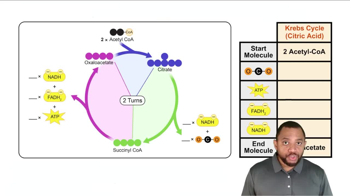
Acetyl CoA and the Citric Acid Cycle

Acetyl CoA is a key molecule that enters the citric acid cycle (Krebs cycle), where it undergoes a series of reactions to produce ATP, NADH, and FADH2. Each acetyl CoA contributes to the generation of energy, with each cycle yielding additional ATP and electron carriers that are vital for cellular respiration. Understanding this cycle is important for calculating the total ATP yield from glucose metabolism.
Recommended video:
Guided course
2:27
Citric Acid Cycle Summary Concept 13