Pearson+ LogoPearson+ Logo
Ch.12 Food as Fuel An Overview of Metabolism
Frost - General, Organic and Biological Chemistry 4th Edition
Frost4th EditionGeneral, Organic and Biological ChemistryISBN: 9780134988696Not the one you use?Change textbook
Chapter 8, Problem 61a

Name the metabolic substrate(s) that can be produced from the carbon atoms of each of the following amino acids:
a. alanine

Verified step by step guidance
1
Understand that alanine is an amino acid with the chemical formula CH3CH(NH2)COOH. It is classified as a glucogenic amino acid, meaning its carbon skeleton can be converted into glucose through gluconeogenesis.
Recognize that alanine undergoes transamination, a process where its amino group is transferred to α-ketoglutarate, forming pyruvate and glutamate. The reaction is catalyzed by the enzyme alanine aminotransferase.
Identify pyruvate as the key metabolic substrate produced from alanine. Pyruvate is a central intermediate in metabolism and can enter various pathways, such as gluconeogenesis to form glucose or the citric acid cycle for energy production.
Note that pyruvate can also be converted into acetyl-CoA, which enters the citric acid cycle, or into lactate under anaerobic conditions. However, the primary substrate derived from alanine is pyruvate.
Summarize that the carbon atoms of alanine are primarily converted into pyruvate, which serves as a versatile metabolic substrate in energy production and biosynthesis pathways.

Verified video answer for a similar problem:

This video solution was recommended by our tutors as helpful for the problem above.
Video duration:
3m
Was this helpful?

Key Concepts

Here are the essential concepts you must grasp in order to answer the question correctly.

Amino Acid Metabolism

Amino acid metabolism involves the biochemical processes that break down amino acids for energy or convert them into other compounds. Each amino acid can be deaminated, where the amino group is removed, allowing the carbon skeleton to enter various metabolic pathways, such as gluconeogenesis or the citric acid cycle.
Recommended video:
Guided course
3:03
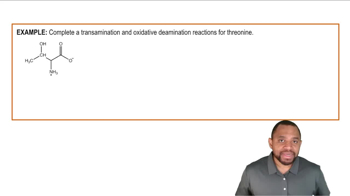
Amino Acid Catabolism: Amino Group Example 2

Gluconeogenesis

Gluconeogenesis is the metabolic pathway that generates glucose from non-carbohydrate substrates, including certain amino acids. Alanine, for instance, can be converted into pyruvate, which is a key intermediate in gluconeogenesis, ultimately leading to the production of glucose, especially during fasting or intense exercise.
Recommended video:
Guided course
1:23
Gluconeogenesis Example 2

Citric Acid Cycle

The citric acid cycle, also known as the Krebs cycle, is a central metabolic pathway that plays a crucial role in energy production. Carbon skeletons from amino acids, after deamination, can be converted into acetyl-CoA or other intermediates that enter the cycle, facilitating the production of ATP and other energy-rich molecules.
Recommended video:
Guided course
2:31
Citric Acid Cycle Summary Concept 12