Pearson+ LogoPearson+ Logo
Ch.12 Food as Fuel An Overview of Metabolism
Frost - General, Organic and Biological Chemistry 4th Edition
Frost4th EditionGeneral, Organic and Biological ChemistryISBN: 9780134988696Not the one you use?Change textbook
Chapter 8, Problem 93c

Consider the complete oxidation of capric acid, a saturated fatty acid, [10:0].
c How many ATP are generated from the complete oxidation of capric acid?

Verified step by step guidance
1
Step 1: Understand the structure of capric acid. Capric acid is a saturated fatty acid with the formula C10H20O2. It contains 10 carbon atoms, no double bonds, and a carboxylic acid functional group.
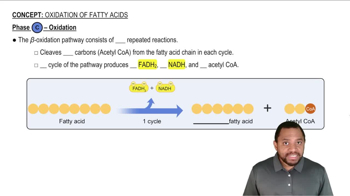
Step 2: Calculate the number of acetyl-CoA molecules produced during β-oxidation. Each cycle of β-oxidation removes two carbons from the fatty acid chain, producing one acetyl-CoA. For a 10-carbon fatty acid, 5 acetyl-CoA molecules are produced.
Step 3: Determine the number of NADH and FADH2 molecules generated during β-oxidation. Each cycle of β-oxidation generates 1 NADH and 1 FADH2. Since there are 4 cycles (10 carbons divided into 5 acetyl-CoA molecules, with 4 cycles required to break the chain), 4 NADH and 4 FADH2 molecules are produced.
Step 4: Calculate the ATP yield from the acetyl-CoA molecules. Each acetyl-CoA enters the citric acid cycle, producing 3 NADH, 1 FADH2, and 1 GTP (equivalent to ATP). Multiply these values by the number of acetyl-CoA molecules (5) to find the total ATP contribution from the citric acid cycle.
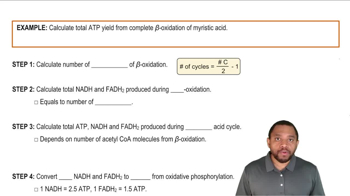
Step 5: Add the ATP contributions from β-oxidation and the citric acid cycle. Convert NADH and FADH2 into ATP using their respective yields (NADH = 2.5 ATP, FADH2 = 1.5 ATP). Sum all ATP contributions to determine the total ATP generated from the complete oxidation of capric acid.

Verified video answer for a similar problem:

This video solution was recommended by our tutors as helpful for the problem above.
Video duration:
3m
Was this helpful?

Key Concepts

Here are the essential concepts you must grasp in order to answer the question correctly.

Fatty Acid Oxidation

Fatty acid oxidation is the metabolic process by which fatty acids are broken down in the mitochondria to generate energy. This process involves the conversion of fatty acids into acetyl-CoA through beta-oxidation, which then enters the citric acid cycle (Krebs cycle) to produce ATP. Understanding this process is crucial for calculating the energy yield from specific fatty acids like capric acid.
Recommended video:
Guided course
1:29
Oxidation of Fatty Acids Concept 3

ATP Yield from Fatty Acids

The ATP yield from fatty acid oxidation can be calculated based on the number of carbon atoms in the fatty acid. Each cycle of beta-oxidation produces one molecule of acetyl-CoA and generates NADH and FADH2, which are further processed in the electron transport chain to produce ATP. For capric acid, which has 10 carbon atoms, the total ATP yield can be determined by considering both the direct ATP produced and the ATP generated from NADH and FADH2.
Recommended video:
Guided course
4:19
Total Energy from Fatty Acids Example 1

Capric Acid Structure and Properties

Capric acid, also known as decanoic acid, is a saturated fatty acid with a 10-carbon chain. Its structure influences its metabolic pathway and energy yield during oxidation. Recognizing the specific characteristics of capric acid, such as its saturation and chain length, is essential for accurately calculating the total ATP produced during its complete oxidation.
Recommended video:
Guided course
0:53
Physical Properties of Fatty Acids Concept 1