Pearson+ LogoPearson+ Logo
Ch.12 Food as Fuel An Overview of Metabolism
Frost - General, Organic and Biological Chemistry 4th Edition
Frost4th EditionGeneral, Organic and Biological ChemistryISBN: 9780134988696Not the one you use?Change textbook
Chapter 8, Problem 97a

Lauric acid, a saturated fatty acid, [12:0], is found in coconut oil.
a. Draw fatty acyl lauric acid activated for β oxidation.

Verified step by step guidance
1
Understand the context: Lauric acid is a saturated fatty acid with the formula C12H24O2. It is represented as [12:0], meaning it has 12 carbon atoms and no double bonds.
Recall the process of fatty acid activation: Before β-oxidation, a fatty acid must be converted into its activated form, which is a fatty acyl-CoA. This involves attaching coenzyme A (CoA) to the fatty acid.
Write the reaction for activation: Lauric acid reacts with ATP and CoA to form lauroyl-CoA (the activated form), AMP, and pyrophosphate (PPi). The reaction can be represented as: C12H24O2 + ATP + CoA → C12H23COSCoA + AMP + PPi.
Draw the structure of lauroyl-CoA: Start with the lauric acid structure (a 12-carbon chain with a carboxylic acid group at one end). Replace the hydroxyl group (-OH) of the carboxylic acid with a thioester bond (-SCoA) to represent the attachment of CoA.
Ensure the structure is correct: Verify that the lauroyl-CoA structure includes the 12-carbon chain, the thioester bond (-SCoA), and no double bonds, as lauric acid is saturated.

Verified video answer for a similar problem:

This video solution was recommended by our tutors as helpful for the problem above.
Video duration:
1m
Was this helpful?

Key Concepts

Here are the essential concepts you must grasp in order to answer the question correctly.

Fatty Acyl CoA

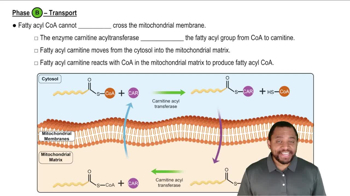
Fatty acyl CoA is a fatty acid that has been activated by the addition of coenzyme A (CoA). This activation is crucial for the transport of fatty acids into the mitochondria, where they undergo β-oxidation. The formation of fatty acyl CoA is catalyzed by the enzyme acyl-CoA synthetase, which converts free fatty acids into their CoA derivatives, making them ready for metabolic processes.
Recommended video:
Guided course
2:11
Oxidation of Fatty Acids Concept 2

β-Oxidation

β-Oxidation is the metabolic process by which fatty acids are broken down in the mitochondria to generate acetyl-CoA, NADH, and FADH2. This process involves a series of enzymatic reactions that sequentially remove two-carbon units from the fatty acid chain. For lauric acid, which has 12 carbon atoms, β-oxidation will yield six acetyl-CoA molecules, which can then enter the citric acid cycle for energy production.

Saturated Fatty Acids

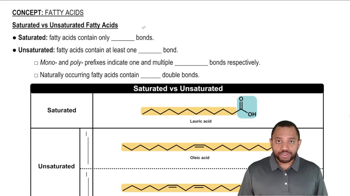
Saturated fatty acids are fatty acids that contain no double bonds between carbon atoms, meaning they are fully 'saturated' with hydrogen atoms. Lauric acid, with the chemical formula C12H24O2, is a typical example of a saturated fatty acid. These fatty acids are typically solid at room temperature and are found in high concentrations in animal fats and certain plant oils, such as coconut oil.
Recommended video:
Guided course
2:26
Fatty Acids Concept 2