Pearson+ LogoPearson+ Logo
Ch.12 Food as Fuel An Overview of Metabolism
Frost - General, Organic and Biological Chemistry 4th Edition
Frost4th EditionGeneral, Organic and Biological ChemistryISBN: 9780134988696Not the one you use?Change textbook
Chapter 8, Problem 84c

Identify the following as the reduced or oxidized form:
c. Q

Verified step by step guidance
1
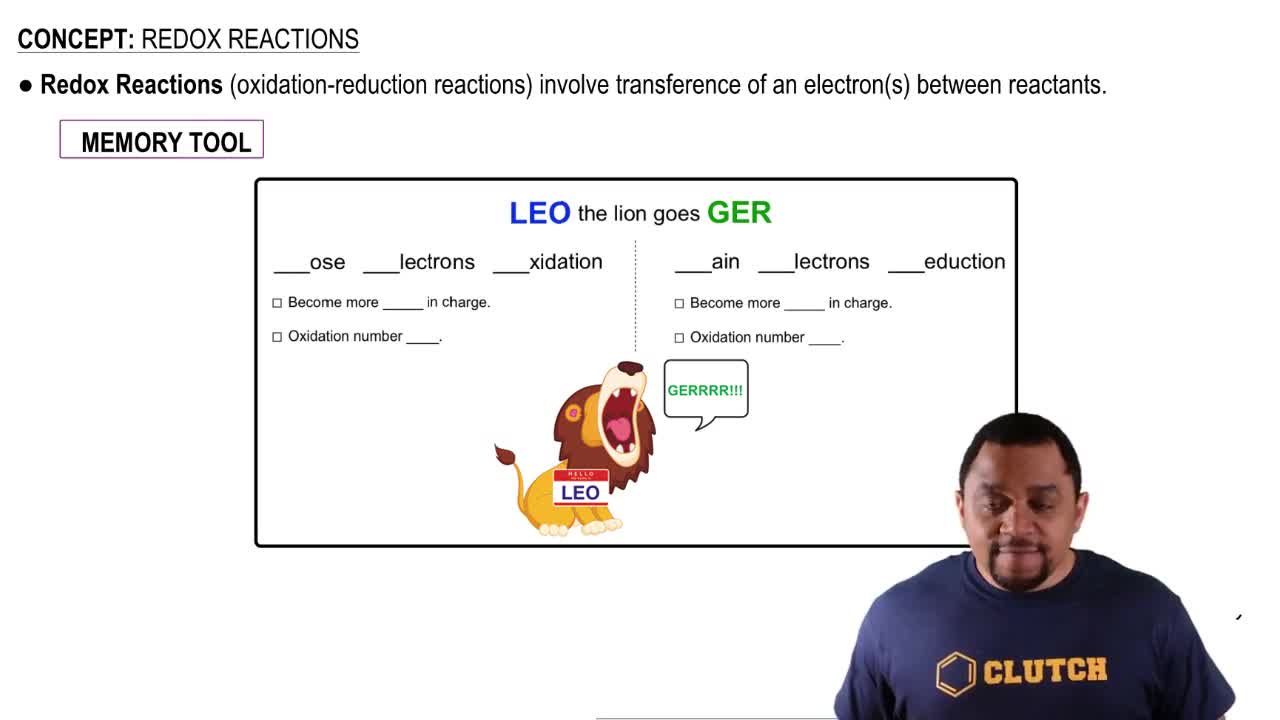
Understand the concepts of oxidation and reduction: Oxidation involves the loss of electrons, while reduction involves the gain of electrons. The oxidized form of a substance has fewer electrons, and the reduced form has more electrons.
Determine the context of the problem: In this case, we are identifying whether 'Q' is in its reduced or oxidized form. This typically requires information about the chemical reaction or the oxidation states of 'Q'.
Examine the oxidation state of 'Q': If 'Q' has gained electrons (its oxidation state has decreased), it is in its reduced form. If 'Q' has lost electrons (its oxidation state has increased), it is in its oxidized form.
Look for any additional information provided in the problem or accompanying material, such as a chemical equation or electron transfer process, to determine the electron change for 'Q'.
Conclude whether 'Q' is reduced or oxidized based on the electron transfer or oxidation state change observed in the context of the problem.

Verified video answer for a similar problem:

This video solution was recommended by our tutors as helpful for the problem above.
Video duration:
1m
Was this helpful?

Key Concepts

Here are the essential concepts you must grasp in order to answer the question correctly.

Redox Reactions

Redox reactions involve the transfer of electrons between two species, leading to changes in their oxidation states. In these reactions, one species is oxidized (loses electrons) while another is reduced (gains electrons). Understanding redox processes is crucial for identifying whether a compound is in its reduced or oxidized form.
Recommended video:
Guided course
01:53
Redox Reactions

Oxidation States

Oxidation states are a way to keep track of electrons in chemical compounds. They indicate the degree of oxidation of an atom in a molecule, helping to determine whether a substance is in its reduced or oxidized form. For example, in organic compounds, the presence of more hydrogen atoms typically indicates a reduced state, while more oxygen or fewer hydrogen atoms suggest oxidation.
Recommended video:
Guided course
01:01
States of Matter Example 1

Coenzyme Q (Ubiquinone)

Coenzyme Q, also known as ubiquinone, is a vital component of the electron transport chain in cellular respiration. It exists in both oxidized (ubiquinone) and reduced (ubiquinol) forms. Recognizing the specific form of Coenzyme Q is essential for understanding its role in energy production and its involvement in redox reactions within the mitochondria.
Recommended video:
Guided course
1:02
Coenzyme A Concept 4