Pearson+ LogoPearson+ Logo
Ch.12 Food as Fuel An Overview of Metabolism
Frost - General, Organic and Biological Chemistry 4th Edition
Frost4th EditionGeneral, Organic and Biological ChemistryISBN: 9780134988696Not the one you use?Change textbook
Chapter 8, Problem 70

If glycolysis occurs in the cytoplasm and the citric acid cycle occurs in the mitochondrial matrix, how do the products of glycolysis get inside the mitochondrial matrix?

Verified step by step guidance
1
Understand that glycolysis produces pyruvate as its main product, along with ATP and NADH. Pyruvate is the molecule that needs to be transported into the mitochondrial matrix for further processing in the citric acid cycle.
Recognize that pyruvate crosses the mitochondrial membrane through a specific transport mechanism. Pyruvate is transported into the mitochondrial matrix via a protein called the pyruvate translocase, which is part of the inner mitochondrial membrane.
Learn that pyruvate translocase works in conjunction with a symport mechanism, where pyruvate is co-transported with protons (H⁺) into the mitochondrial matrix. This process is driven by the proton gradient across the inner mitochondrial membrane.
Once inside the mitochondrial matrix, pyruvate undergoes a chemical reaction catalyzed by the enzyme pyruvate dehydrogenase complex. This reaction converts pyruvate into acetyl-CoA, which is the starting molecule for the citric acid cycle.
Understand that the citric acid cycle then takes place in the mitochondrial matrix, where acetyl-CoA is further metabolized to produce energy-rich molecules such as NADH, FADH₂, and ATP, which are essential for cellular energy production.

Verified video answer for a similar problem:

This video solution was recommended by our tutors as helpful for the problem above.
Video duration:
4m
Was this helpful?

Key Concepts

Here are the essential concepts you must grasp in order to answer the question correctly.

Glycolysis

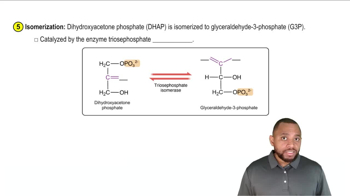
Glycolysis is the metabolic pathway that converts glucose into pyruvate, producing a small amount of ATP and NADH in the process. This occurs in the cytoplasm of the cell and is the first step in cellular respiration, providing the necessary substrates for further energy production in the mitochondria.
Recommended video:
Guided course
1:26
Glycolysis Concept 5

Mitochondrial Transport Mechanisms

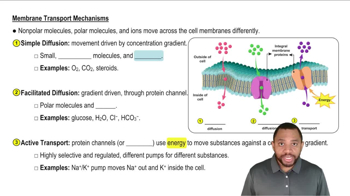
Mitochondrial transport mechanisms are specialized processes that facilitate the movement of metabolites and ions across the mitochondrial membranes. Pyruvate, the end product of glycolysis, is transported into the mitochondrial matrix via specific transport proteins, allowing it to enter the citric acid cycle for further energy extraction.
Recommended video:
Guided course
3:01
Membrane Transport Concept 2

Citric Acid Cycle

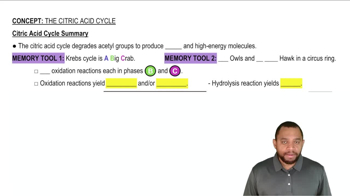
The citric acid cycle, also known as the Krebs cycle, is a series of chemical reactions that occur in the mitochondrial matrix. It processes acetyl-CoA, derived from pyruvate, to produce ATP, NADH, and FADH2, which are crucial for the electron transport chain and overall cellular energy production.
Recommended video:
Guided course
2:31
Citric Acid Cycle Summary Concept 12