Pearson+ LogoPearson+ Logo
Ch.12 Food as Fuel An Overview of Metabolism
Frost - General, Organic and Biological Chemistry 4th Edition
Frost4th EditionGeneral, Organic and Biological ChemistryISBN: 9780134988696Not the one you use?Change textbook
Chapter 8, Problem 67b

Identify the type of food—carbohydrate, fat, or protein—that gives each of the following digestion products:
b. fatty acid

Verified step by step guidance
1
Understand the digestion process: Different types of food (carbohydrates, fats, and proteins) are broken down into specific products during digestion. Carbohydrates break down into monosaccharides, proteins into amino acids, and fats into fatty acids and glycerol.
Recall the structure of fats: Fats, also known as triglycerides, consist of three fatty acid chains attached to a glycerol backbone. During digestion, these fatty acid chains are released.
Identify the enzyme involved: The enzyme lipase is responsible for breaking down fats into fatty acids and glycerol in the digestive system.
Connect the digestion product to the food type: Since fatty acids are produced when fats are broken down, the food type associated with fatty acids is fat.
Summarize the answer: Fatty acids are a digestion product of fats, not carbohydrates or proteins.

Verified video answer for a similar problem:

This video solution was recommended by our tutors as helpful for the problem above.
Video duration:
2m
Was this helpful?

Key Concepts

Here are the essential concepts you must grasp in order to answer the question correctly.

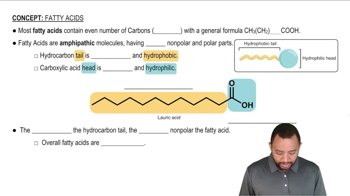
Fatty Acids

Fatty acids are the building blocks of fats and oils, which are classified as lipids. They are long chains of hydrocarbons that can be saturated or unsaturated, depending on the presence of double bonds. In digestion, fats are broken down into fatty acids and glycerol, which can then be absorbed by the body for energy or used in various metabolic processes.
Recommended video:
Guided course
2:00
Fatty Acids Concept 1

Types of Nutrients

Nutrients are substances that provide essential nourishment for the body. The three main types of macronutrients are carbohydrates, proteins, and fats. Each type serves different functions: carbohydrates provide quick energy, proteins are crucial for growth and repair, and fats are important for energy storage and cellular structure.
Recommended video:
Guided course
03:27
Types of Radiation Concept 2

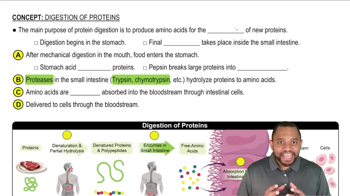
Digestion Process

The digestion process involves the breakdown of food into smaller components that can be absorbed by the body. This process begins in the mouth and continues in the stomach and intestines, where enzymes and acids break down macronutrients. Understanding how different foods are digested helps identify the specific products, such as fatty acids from fats.
Recommended video:
Guided course
2:01
Digestion of Proteins Concept 1