
Pearson+ LogoPearson+ Logo
Ch.12 Food as Fuel An Overview of Metabolism
Frost - General, Organic and Biological Chemistry 4th Edition
Frost4th EditionGeneral, Organic and Biological ChemistryISBN: 9780134988696Not the one you use?Change textbook
Chapter 8, Problem 71a

Which of the following reactions in glycolysis produce ATP or NADH?
a. 1,3-bisphosphoglycerate to 3-phosphoglycerate

Verified step by step guidance
1
Step 1: Understand the context of glycolysis, which is a metabolic pathway that breaks down glucose into pyruvate, producing ATP and NADH as energy carriers.
Step 2: Recall that ATP is produced during substrate-level phosphorylation, and NADH is produced during oxidation-reduction reactions in glycolysis.
Step 3: Analyze the given reaction: 1,3-bisphosphoglycerate to 3-phosphoglycerate. This step involves the transfer of a phosphate group from 1,3-bisphosphoglycerate to ADP, forming ATP. This is an example of substrate-level phosphorylation.
Step 4: Note that this reaction does not involve the transfer of electrons or hydrogen atoms, so NADH is not produced in this step.
Step 5: Conclude that the reaction from 1,3-bisphosphoglycerate to 3-phosphoglycerate produces ATP but not NADH.

Verified video answer for a similar problem:

This video solution was recommended by our tutors as helpful for the problem above.
Video duration:
5m
Was this helpful?

Key Concepts

Here are the essential concepts you must grasp in order to answer the question correctly.

Glycolysis

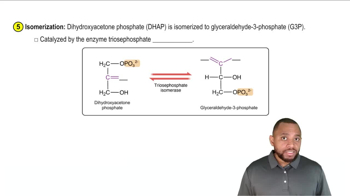
Glycolysis is a metabolic pathway that converts glucose into pyruvate, producing energy in the form of ATP and NADH. It occurs in the cytoplasm of cells and consists of ten enzyme-catalyzed reactions. Understanding glycolysis is essential for identifying which specific reactions yield ATP or NADH.
Recommended video:
Guided course
1:26
Glycolysis Concept 5

ATP Production

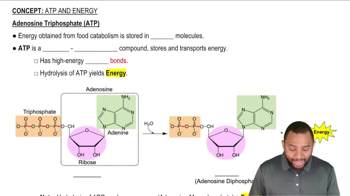
ATP (adenosine triphosphate) is the primary energy currency of the cell. In glycolysis, ATP is produced through substrate-level phosphorylation, where a phosphate group is directly transferred to ADP from a phosphorylated intermediate. Recognizing the steps in glycolysis that generate ATP is crucial for answering questions about energy yield.
Recommended video:
Guided course
2:20
Adenosine Triphosphate (ATP) Concept 2

NADH Production

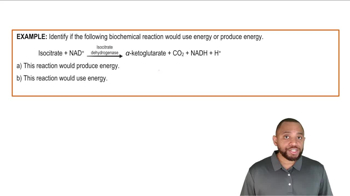
NADH (nicotinamide adenine dinucleotide) is a coenzyme that plays a key role in cellular respiration by carrying electrons to the electron transport chain. In glycolysis, NADH is produced during the conversion of glyceraldehyde-3-phosphate to 1,3-bisphosphoglycerate. Identifying the reactions that produce NADH is important for understanding the overall energy balance of glycolysis.
Recommended video:
Guided course
1:08
Energy Production In Biochemical Pathways Example 1