Pearson+ LogoPearson+ Logo
Ch.12 Food as Fuel An Overview of Metabolism
Frost - General, Organic and Biological Chemistry 4th Edition
Frost4th EditionGeneral, Organic and Biological ChemistryISBN: 9780134988696Not the one you use?Change textbook
Chapter 8, Problem 63b

Name the location in the cell where the following catabolic processes take place:
b. citric acid cycle

Verified step by step guidance
1
Understand that the citric acid cycle, also known as the Krebs cycle or TCA cycle, is a key metabolic pathway involved in energy production.
Recall that the citric acid cycle occurs in eukaryotic cells, specifically within the mitochondria.
Identify the exact location within the mitochondria where the cycle takes place: the matrix, which is the innermost compartment of the mitochondria.
Note that the matrix contains the enzymes necessary for the reactions of the citric acid cycle to proceed.
Recognize the importance of the citric acid cycle in generating high-energy molecules like NADH and FADH₂, which are used in the electron transport chain for ATP production.

Verified video answer for a similar problem:

This video solution was recommended by our tutors as helpful for the problem above.
Video duration:
3m
Was this helpful?

Key Concepts

Here are the essential concepts you must grasp in order to answer the question correctly.

Citric Acid Cycle

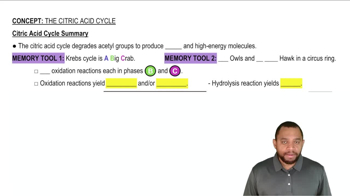
The citric acid cycle, also known as the Krebs cycle, is a key metabolic pathway that occurs in the mitochondria of eukaryotic cells. It plays a crucial role in cellular respiration by oxidizing acetyl-CoA to produce energy in the form of ATP, as well as electron carriers like NADH and FADH2, which are essential for the electron transport chain.
Recommended video:
Guided course
2:31
Citric Acid Cycle Summary Concept 12

Mitochondria

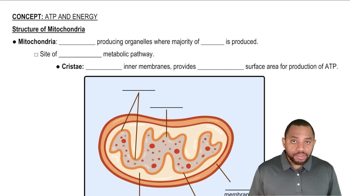
Mitochondria are membrane-bound organelles found in eukaryotic cells, often referred to as the 'powerhouses' of the cell. They are responsible for producing ATP through oxidative phosphorylation and the citric acid cycle, making them vital for energy metabolism and overall cellular function.
Recommended video:
Guided course
1:46
Structure of Mitochondria Concept 1

Catabolic Processes

Catabolic processes refer to metabolic pathways that break down molecules to release energy. In the context of cellular respiration, these processes include glycolysis, the citric acid cycle, and the electron transport chain, all of which contribute to the conversion of biochemical energy from nutrients into ATP.
Recommended video:
Guided course
2:25
Processing of Pre-mRNA Concept 1