Pearson+ LogoPearson+ Logo
Ch.12 Food as Fuel An Overview of Metabolism
Frost - General, Organic and Biological Chemistry 4th Edition
Frost4th EditionGeneral, Organic and Biological ChemistryISBN: 9780134988696Not the one you use?Change textbook
Chapter 8, Problem 79d

Refer to the diagram of the citric acid cycle in Figure 12.11 to answer each of the following:
d. Name the reactions where secondary alcohols are oxidized to ketones.

Verified step by step guidance
1
Identify the secondary alcohols in the citric acid cycle. Secondary alcohols are characterized by a hydroxyl group (-OH) attached to a carbon atom that is also bonded to two other carbon atoms.
Locate the steps in the citric acid cycle where these secondary alcohols undergo oxidation. Oxidation involves the loss of hydrogen atoms or electrons, resulting in the formation of a ketone group (C=O).
Refer to the specific enzymes involved in these oxidation reactions. In the citric acid cycle, dehydrogenase enzymes typically catalyze oxidation reactions.
Match the reactions to their corresponding intermediates in the citric acid cycle. For example, identify the conversion of isocitrate to α-ketoglutarate, which involves the oxidation of a secondary alcohol to a ketone.
Summarize the reactions by naming the specific steps and intermediates where secondary alcohols are oxidized to ketones, ensuring clarity and accuracy in your response.

Verified video answer for a similar problem:

This video solution was recommended by our tutors as helpful for the problem above.
Video duration:
4m
Was this helpful?

Key Concepts

Here are the essential concepts you must grasp in order to answer the question correctly.

Citric Acid Cycle

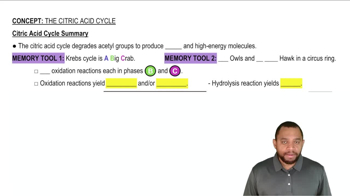
The citric acid cycle, also known as the Krebs cycle, is a series of chemical reactions used by all aerobic organisms to generate energy. It involves the oxidation of acetyl-CoA to carbon dioxide and water, producing ATP, NADH, and FADH2. Understanding this cycle is crucial for identifying specific reactions, such as those involving secondary alcohols.
Recommended video:
Guided course
2:31
Citric Acid Cycle Summary Concept 12

Oxidation of Alcohols

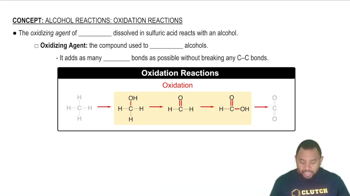
Oxidation of alcohols refers to the chemical process where alcohols lose electrons, often resulting in the formation of carbonyl compounds. In the context of the citric acid cycle, secondary alcohols are oxidized to ketones through specific enzymatic reactions, which are essential for energy production and metabolic pathways.
Recommended video:
Guided course
1:49
Alcohol Reactions: Oxidation Concept 1

Enzymatic Reactions

Enzymatic reactions are biochemical processes facilitated by enzymes, which act as catalysts to speed up reactions without being consumed. In the citric acid cycle, specific enzymes catalyze the oxidation of secondary alcohols to ketones, highlighting the importance of enzyme specificity and regulation in metabolic pathways.
Recommended video:
Guided course
3:09
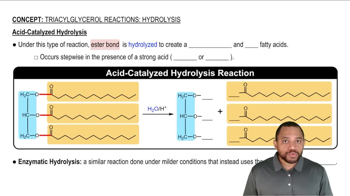
Triacylglycerol Reactions: Hydrolysis Concept 1