Pearson+ LogoPearson+ Logo
Ch.5 Chemical Reactions
Frost - General, Organic and Biological Chemistry 4th Edition
Frost4th EditionGeneral, Organic and Biological ChemistryISBN: 9780134988696Not the one you use?Change textbook
Chapter 2, Problem 72a

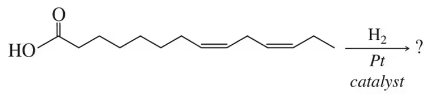
Fill in the missing organic products for the complete hydrogenation of the following:
(a)

Verified step by step guidance
1
Identify the type of organic compound in the given image. For complete hydrogenation, the compound is likely an alkene or alkyne, as these undergo hydrogenation reactions.
Understand that complete hydrogenation involves the addition of hydrogen (H₂) across the double or triple bonds in the molecule, converting them into single bonds.
Write the general reaction for hydrogenation: CnH2n + H2 → CnH2n+2 for alkenes or CnH2n-2 + 2H2 → CnH2n+2 for alkynes.
Determine the structure of the product by replacing all double or triple bonds in the original molecule with single bonds, ensuring that each carbon atom achieves a full octet by bonding with additional hydrogen atoms.
Verify the final product by counting the number of carbon and hydrogen atoms to ensure the molecular formula matches the expected result after complete hydrogenation.

Verified video answer for a similar problem:

This video solution was recommended by our tutors as helpful for the problem above.
Video duration:
1m
Was this helpful?

Key Concepts

Here are the essential concepts you must grasp in order to answer the question correctly.

Hydrogenation

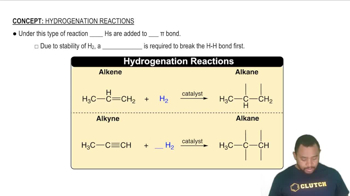
Hydrogenation is a chemical reaction that involves the addition of hydrogen (H2) to an unsaturated organic compound, typically alkenes or alkynes, converting them into saturated hydrocarbons. This process is commonly used in the food industry to convert liquid vegetable oils into solid or semi-solid fats, such as margarine. Understanding the mechanism of hydrogenation is crucial for predicting the products formed in the reaction.
Recommended video:
Guided course
1:22
Hydrogenation Reactions Concept 1

Saturated vs. Unsaturated Compounds

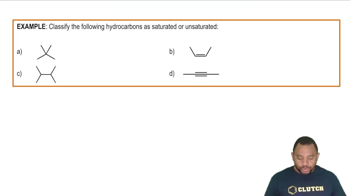
Saturated compounds contain only single bonds between carbon atoms, resulting in the maximum number of hydrogen atoms attached to the carbon skeleton. In contrast, unsaturated compounds have one or more double or triple bonds, which means they can react with hydrogen to become saturated. Recognizing the difference between these types of compounds is essential for determining the outcome of hydrogenation reactions.
Recommended video:
Guided course
0:57
Saturated and Unsaturated Hydrocarbons Example 2

Reaction Conditions

The conditions under which hydrogenation occurs, such as temperature, pressure, and the presence of catalysts (like palladium or platinum), significantly influence the reaction's efficiency and the products formed. Typically, higher pressures and temperatures can enhance the reaction rate, while catalysts lower the activation energy required for the reaction. Understanding these conditions helps in predicting the completeness and selectivity of the hydrogenation process.
Recommended video:
Guided course
1:13
Benzene Reactions Concept 1