Pearson+ LogoPearson+ Logo
Ch.5 Chemical Reactions
Frost - General, Organic and Biological Chemistry 4th Edition
Frost4th EditionGeneral, Organic and Biological ChemistryISBN: 9780134988696Not the one you use?Change textbook
Chapter 2, Problem 65b

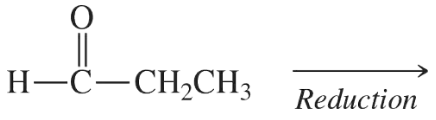
Write the products of the following reactions:
(b)

Verified step by step guidance
1
Identify the type of chemical reaction depicted in the image (e.g., synthesis, decomposition, single replacement, double replacement, or combustion). This will help determine the general pattern of the products.
Examine the reactants in the image and determine their chemical formulas. Ensure you understand the molecular structure and bonding of each reactant.
Apply the rules of chemical reactions to predict the products. For example, in a double replacement reaction, the cations and anions of the reactants swap partners to form new compounds.
Write the chemical formulas of the products based on the reaction type and ensure they are balanced according to the law of conservation of mass. Use stoichiometric coefficients to balance the equation.
Double-check the products for correctness, ensuring that the charges of ions are balanced and the chemical formulas are valid. If applicable, verify the physical states of the products (solid, liquid, gas, or aqueous).

Verified video answer for a similar problem:

This video solution was recommended by our tutors as helpful for the problem above.
Video duration:
2m
Was this helpful?

Key Concepts

Here are the essential concepts you must grasp in order to answer the question correctly.

Chemical Reactions

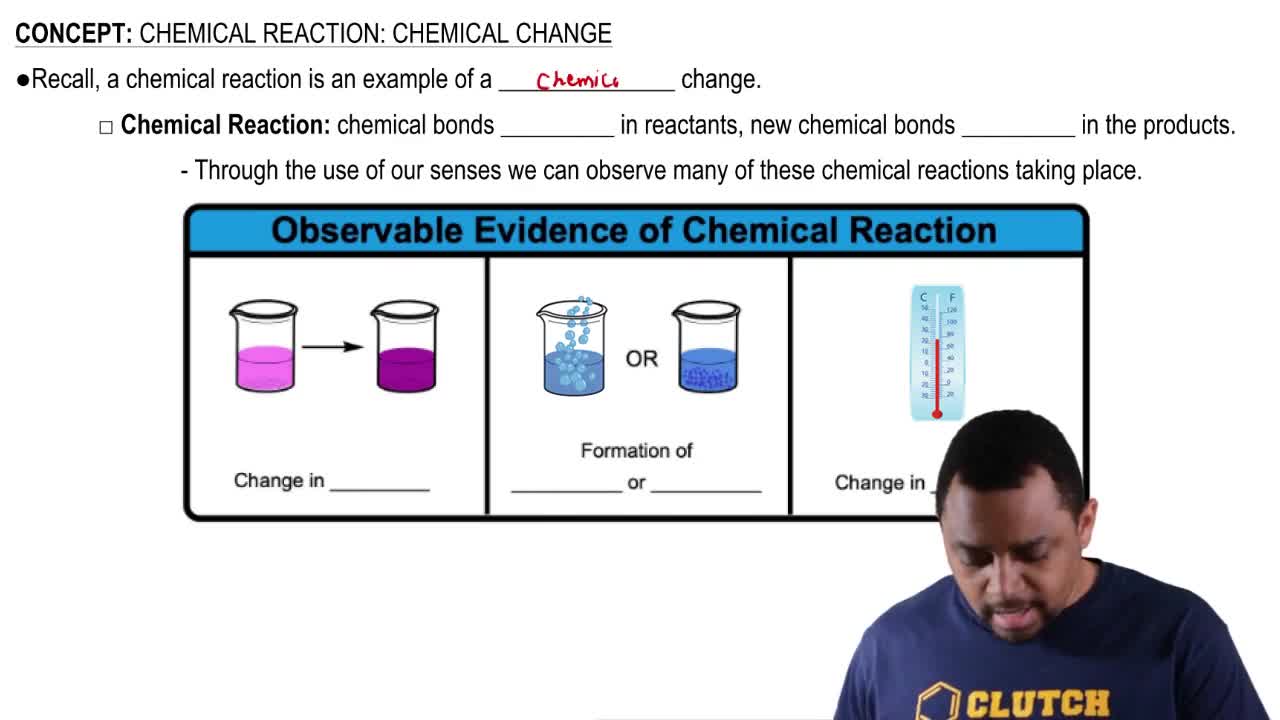
Chemical reactions involve the transformation of reactants into products through the breaking and forming of chemical bonds. Understanding the types of reactions, such as synthesis, decomposition, single replacement, and double replacement, is essential for predicting the products formed in a given reaction.
Recommended video:
Guided course
00:58
Chemical Reaction: Chemical Change Concept 1

Stoichiometry

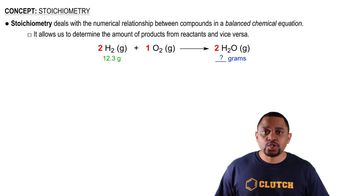
Stoichiometry is the calculation of reactants and products in chemical reactions based on the conservation of mass. It allows chemists to determine the proportions of elements and compounds involved, which is crucial for accurately predicting the products of a reaction and understanding the quantitative relationships between them.
Recommended video:
Guided course
01:16
Stoichiometry

Reaction Mechanisms

Reaction mechanisms describe the step-by-step sequence of elementary reactions that lead to the overall chemical change. Understanding the mechanism helps in predicting the products and the conditions under which the reaction occurs, as well as the intermediates formed during the process.
Recommended video:
Guided course
1:30
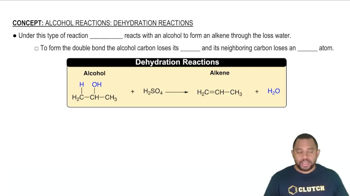
Alcohol Reactions: Dehydration Reactions Concept 1