Pearson+ LogoPearson+ Logo
Ch.5 Chemical Reactions
Frost - General, Organic and Biological Chemistry 4th Edition
Frost4th EditionGeneral, Organic and Biological ChemistryISBN: 9780134988696Not the one you use?Change textbook
Chapter 2, Problem 63b

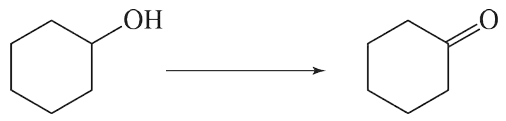
Determine whether each of the following organic reactions is an oxidation or a reduction reaction. (Only the organic compounds are shown.)
(b)

Verified step by step guidance
1
Step 1: Understand the concepts of oxidation and reduction in organic chemistry. Oxidation typically involves the loss of hydrogen atoms or the gain of oxygen atoms, while reduction involves the gain of hydrogen atoms or the loss of oxygen atoms.
Step 2: Examine the chemical structure of the organic compound before and after the reaction. Look for changes in the number of hydrogen atoms or oxygen atoms attached to the carbon atoms.
Step 3: If the organic compound gains oxygen atoms or loses hydrogen atoms during the reaction, classify the reaction as an oxidation reaction.
Step 4: If the organic compound gains hydrogen atoms or loses oxygen atoms during the reaction, classify the reaction as a reduction reaction.
Step 5: Apply these principles to the specific reaction shown in the image to determine whether it is an oxidation or reduction reaction.

Verified video answer for a similar problem:

This video solution was recommended by our tutors as helpful for the problem above.
Video duration:
1m
Was this helpful?

Key Concepts

Here are the essential concepts you must grasp in order to answer the question correctly.

Oxidation and Reduction Reactions

Oxidation and reduction (redox) reactions are chemical processes that involve the transfer of electrons between substances. Oxidation refers to the loss of electrons or an increase in oxidation state, while reduction involves the gain of electrons or a decrease in oxidation state. Understanding these definitions is crucial for identifying whether a reaction is an oxidation or reduction.
Recommended video:
Guided course
2:38
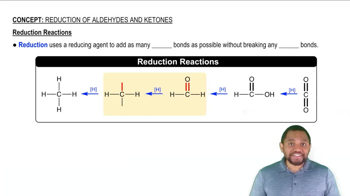
Reduction Reactions Concept 1

Oxidation States

Oxidation states (or oxidation numbers) are a way to keep track of electron transfer in redox reactions. Each atom in a molecule is assigned an oxidation state based on its electron configuration and bonding. By analyzing the changes in oxidation states of the organic compounds involved in the reaction, one can determine if the reaction is an oxidation or reduction.
Recommended video:
Guided course
01:01
States of Matter Example 1

Functional Groups in Organic Chemistry

Functional groups are specific groups of atoms within molecules that are responsible for the characteristic chemical reactions of those molecules. In organic chemistry, the presence of certain functional groups can indicate potential oxidation or reduction reactions. Recognizing these groups helps in predicting how organic compounds will behave during chemical transformations.
Recommended video:
Guided course
1:10
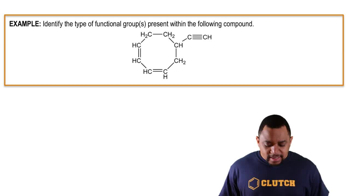
Functional Groups In Chemistry Example 1