Pearson+ LogoPearson+ Logo
Ch.6 Carbohydrates Life's Sweet Molecules
Frost - General, Organic and Biological Chemistry 4th Edition
Frost4th EditionGeneral, Organic and Biological ChemistryISBN: 9780134988696Not the one you use?Change textbook
Chapter 3, Problem 43a

Describe the similarities and differences of the following polysaccharides:
(a) amylose and amylopectin

Verified step by step guidance
1
Amylose and amylopectin are both polysaccharides composed of glucose monomers, making them similar in their basic building blocks.
Amylose is a linear polymer, meaning its glucose units are connected in a straight chain via α(1→4) glycosidic bonds. This structure allows it to form helical shapes.
Amylopectin, on the other hand, is a branched polymer. It contains α(1→4) glycosidic bonds in its linear sections and α(1→6) glycosidic bonds at the branch points.
Amylose is less soluble in water compared to amylopectin due to its linear structure, while amylopectin's branched structure makes it more soluble and easier to digest.
Both amylose and amylopectin are components of starch, but amylopectin is more abundant in starch, typically making up about 70-80% of its composition.

Verified video answer for a similar problem:

This video solution was recommended by our tutors as helpful for the problem above.
Video duration:
4m
Was this helpful?

Key Concepts

Here are the essential concepts you must grasp in order to answer the question correctly.

Polysaccharides

Polysaccharides are complex carbohydrates composed of long chains of monosaccharide units linked by glycosidic bonds. They serve various functions in living organisms, including energy storage and structural support. Common examples include starch, glycogen, and cellulose, each differing in their monomer composition and linkage types.
Recommended video:
Guided course
1:24
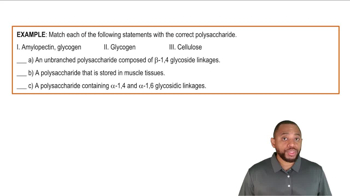
Polysaccharides Example 1

Amylose

Amylose is a linear form of starch, consisting of long, unbranched chains of glucose molecules connected by α(1→4) glycosidic bonds. It typically makes up about 20-30% of starch and is known for its ability to form helical structures, which can influence its solubility and digestibility. Amylose is primarily used for energy storage in plants.
Recommended video:
Guided course
0:50
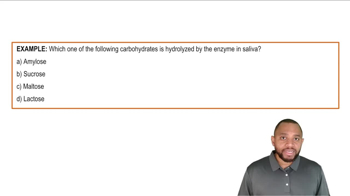
Intro To Carbohydrate Metabolism Example 1

Amylopectin

Amylopectin is a highly branched form of starch, composed of glucose units linked by both α(1→4) and α(1→6) glycosidic bonds. It constitutes about 70-80% of starch and has a more complex structure than amylose, allowing for rapid energy release. The branching structure of amylopectin contributes to its solubility and digestibility compared to amylose.
Recommended video:
Guided course
1:24
Polysaccharides Example 1