Pearson+ LogoPearson+ Logo
Ch.6 Carbohydrates Life's Sweet Molecules
Frost - General, Organic and Biological Chemistry 4th Edition
Frost4th EditionGeneral, Organic and Biological ChemistryISBN: 9780134988696Not the one you use?Change textbook
Chapter 3, Problem 46d

Give the name of one or more polysaccharides that matches each of the following descriptions:
(d) produces maltose during digestion

Verified step by step guidance
1
Understand the term 'polysaccharide': Polysaccharides are large carbohydrate molecules composed of long chains of monosaccharide units linked by glycosidic bonds. They serve various functions, such as energy storage and structural support.
Recall the process of digestion: During digestion, polysaccharides are broken down into smaller units by enzymes. For example, starch is hydrolyzed into maltose by the enzyme amylase.
Identify polysaccharides that produce maltose: Starch and glycogen are polysaccharides that, when digested, produce maltose as an intermediate product. This occurs because they are composed of glucose units linked by α-1,4-glycosidic bonds.
Explain the role of enzymes: Amylase is the enzyme responsible for breaking down starch and glycogen into maltose during digestion. This is an essential step in carbohydrate metabolism.
Conclude with examples: Starch (found in plants) and glycogen (found in animals) are polysaccharides that produce maltose during digestion. These are key sources of energy in biological systems.

Verified video answer for a similar problem:

This video solution was recommended by our tutors as helpful for the problem above.
Video duration:
2m
Was this helpful?

Key Concepts

Here are the essential concepts you must grasp in order to answer the question correctly.

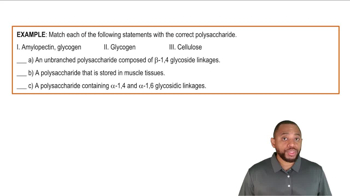
Polysaccharides

Polysaccharides are large, complex carbohydrates composed of long chains of monosaccharide units. They serve various functions in living organisms, including energy storage and structural support. Common examples include starch, glycogen, and cellulose. Understanding polysaccharides is essential for identifying their roles in digestion and metabolism.
Recommended video:
Guided course
1:24
Polysaccharides Example 1

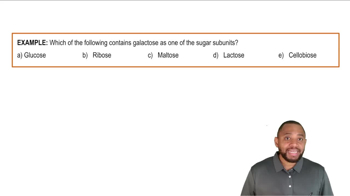
Maltose

Maltose is a disaccharide sugar formed from two glucose molecules. It is produced during the digestion of starch, a polysaccharide, by the action of enzymes such as amylase. Maltose plays a crucial role in energy metabolism and is further broken down into glucose for absorption in the body. Recognizing the relationship between polysaccharides and maltose is key to answering the question.
Recommended video:
Guided course
0:50
Types of Disaccharides Example 1

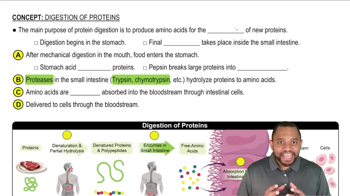
Enzymatic Digestion

Enzymatic digestion refers to the biochemical process where enzymes break down complex molecules into simpler ones. In the context of polysaccharides, enzymes like amylase hydrolyze starch into maltose and other sugars. This process is vital for nutrient absorption and energy production in organisms. Understanding enzymatic digestion helps clarify how polysaccharides yield maltose during digestion.
Recommended video:
Guided course
2:01
Digestion of Proteins Concept 1