Pearson+ LogoPearson+ Logo
Ch.6 Carbohydrates Life's Sweet Molecules
Frost - General, Organic and Biological Chemistry 4th Edition
Frost4th EditionGeneral, Organic and Biological ChemistryISBN: 9780134988696Not the one you use?Change textbook
Chapter 3, Problem 65

Draw the Fischer projection of the C3 epimer of D-glucose. Compare your structure with those in Table 6.1 and give the name of this compound.

Verified step by step guidance
1
Understand the concept of epimers: Epimers are stereoisomers that differ in configuration at only one chiral center. In this case, the C3 epimer of D-glucose means the configuration at the third carbon atom will be inverted compared to D-glucose.
Review the Fischer projection of D-glucose: D-glucose is a six-carbon aldose with the following configuration in its Fischer projection: the hydroxyl groups (-OH) on C2, C4, and C5 are on the right side, while the hydroxyl group on C3 is on the left side.
Invert the configuration at C3: To create the C3 epimer, change the position of the hydroxyl group at the third carbon. In the Fischer projection, move the hydroxyl group from the left side to the right side at C3, while keeping the configurations at all other chiral centers unchanged.
Compare the resulting structure with Table 6.1: After modifying the Fischer projection, compare the new structure to the compounds listed in Table 6.1 to identify the name of the C3 epimer of D-glucose.
Name the compound: Based on the comparison, the C3 epimer of D-glucose is identified as D-allose. Ensure the name matches the structure derived from the inversion at C3.

Verified video answer for a similar problem:

This video solution was recommended by our tutors as helpful for the problem above.
Video duration:
3m
Was this helpful?

Key Concepts

Here are the essential concepts you must grasp in order to answer the question correctly.

Fischer Projection

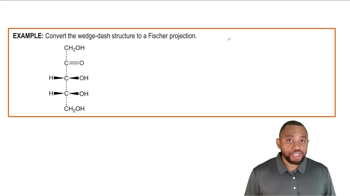
The Fischer projection is a two-dimensional representation of a three-dimensional organic molecule, particularly useful for depicting carbohydrates. In this format, the vertical lines represent bonds that are oriented away from the viewer, while horizontal lines represent bonds that are coming towards the viewer. This method simplifies the visualization of stereochemistry, allowing for easy identification of chiral centers and their configurations.
Recommended video:
Guided course
0:48
Fischer Projections Example 1

C3 Epimer

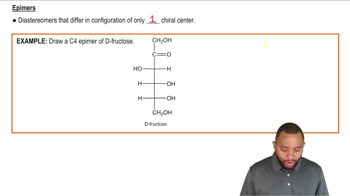
C3 epimers are a specific type of diastereomer that differ in configuration at only one chiral center, in this case, the third carbon atom of the sugar molecule. For d-glucose, the C3 epimer is d-mannose, which has a different spatial arrangement of atoms at the third carbon. Understanding epimerization is crucial for distinguishing between similar sugars and their biological roles.
Recommended video:
Guided course
1:26
D vs L Enantiomers Example 2

D-Glucose

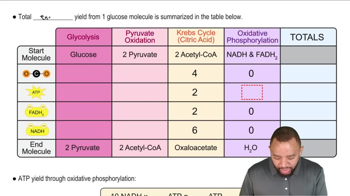
D-glucose is a simple sugar and an important carbohydrate in biology, serving as a primary energy source for cells. It is a six-carbon aldose with the molecular formula C6H12O6 and exists in various forms, including linear and cyclic structures. Recognizing its structure and derivatives, such as epimers, is essential for understanding carbohydrate chemistry and metabolism.
Recommended video:
Guided course
2:48
Total Energy From Glucose Concept 2