Pearson+ LogoPearson+ Logo
Ch.6 Carbohydrates Life's Sweet Molecules
Frost - General, Organic and Biological Chemistry 4th Edition
Frost4th EditionGeneral, Organic and Biological ChemistryISBN: 9780134988696Not the one you use?Change textbook
Chapter 3, Problem 71

Draw the Fischer projection of the product of the oxidation of D-galactose at C1.

Verified step by step guidance
1
Understand the context: D-galactose is a monosaccharide, specifically an aldose sugar, meaning it contains an aldehyde group at C1. Oxidation at C1 converts the aldehyde group (-CHO) into a carboxylic acid group (-COOH), forming an aldonic acid.
Recall the Fischer projection: A Fischer projection is a two-dimensional representation of a molecule where the carbon chain is vertical, and horizontal lines represent bonds projecting out of the plane toward the viewer.
Modify the structure: In the Fischer projection of D-galactose, replace the aldehyde group at C1 with a carboxylic acid group (-COOH). The rest of the molecule remains unchanged, including the hydroxyl groups (-OH) on the other carbons.
Ensure stereochemistry is preserved: Verify that the orientation of the hydroxyl groups (-OH) on carbons 2 through 5 remains consistent with the original D-galactose structure. This ensures the product retains the D-configuration.
Label the product: The resulting molecule is D-galactonic acid. Double-check the Fischer projection to confirm that the vertical chain starts with the carboxylic acid group at C1 and ends with the CH2OH group at C6.

Verified video answer for a similar problem:

This video solution was recommended by our tutors as helpful for the problem above.
Video duration:
3m
Was this helpful?

Key Concepts

Here are the essential concepts you must grasp in order to answer the question correctly.

Fischer Projection

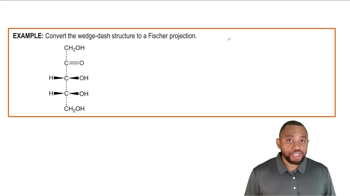
The Fischer projection is a two-dimensional representation of a three-dimensional organic molecule, particularly useful for depicting carbohydrates. In this format, the carbon chain is arranged vertically, with the most oxidized carbon at the top. Horizontal lines represent bonds that project out of the plane towards the viewer, while vertical lines indicate bonds that extend back into the plane.
Recommended video:
Guided course
0:48
Fischer Projections Example 1

Oxidation of Sugars

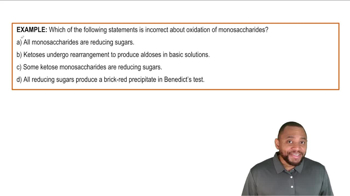
Oxidation of sugars involves the loss of electrons or an increase in oxidation state, often resulting in the formation of aldehydes or ketones. In the case of d-galactose, oxidation at C1 converts the aldehyde group into a carboxylic acid, leading to the formation of d-galactonic acid. Understanding this process is crucial for accurately drawing the resulting Fischer projection.
Recommended video:
Guided course
1:01
Ketoses as Reducing Sugars Example 2

D-Galactose Structure

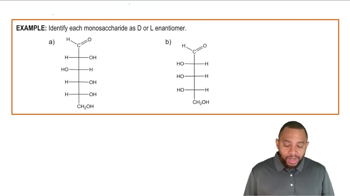
D-galactose is a six-carbon aldose sugar with a specific stereochemistry that influences its reactivity and properties. It has four chiral centers, and its configuration at these centers determines its biological function and interactions. Recognizing the structure of d-galactose is essential for predicting the outcome of its oxidation and accurately representing the product in a Fischer projection.
Recommended video:
Guided course
0:56
D vs L Enantiomers Example 1