Pearson+ LogoPearson+ Logo
Ch.6 Carbohydrates Life's Sweet Molecules
Frost - General, Organic and Biological Chemistry 4th Edition
Frost4th EditionGeneral, Organic and Biological ChemistryISBN: 9780134988696Not the one you use?Change textbook
Chapter 3, Problem 23a

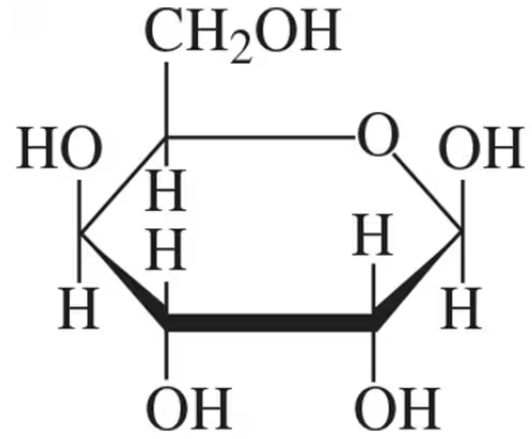
Identify the following carbohydrates as the ⍺ or β anomer:
(a) Cyclic structure of a monosaccharide with labeled hydroxyl groups and a CH2OH group, indicating anomer identification.

Verified step by step guidance
1
Examine the structure of the carbohydrate provided in the image. Specifically, focus on the anomeric carbon, which is the carbon attached to two oxygen atoms: one in the ring and one in the hydroxyl (-OH) group.
Determine the orientation of the hydroxyl (-OH) group attached to the anomeric carbon. If the -OH group is pointing down (opposite to the CH2OH group on the last carbon of the ring), it is the α-anomer. If the -OH group is pointing up (same side as the CH2OH group), it is the ß-anomer.
Identify the CH2OH group on the last carbon of the ring (typically carbon 5 in a six-membered ring). This group helps establish the reference direction for determining the orientation of the -OH group on the anomeric carbon.
Compare the orientation of the -OH group on the anomeric carbon to the CH2OH group. Use the rules from step 2 to classify the carbohydrate as either the α or ß anomer.
Label the carbohydrate as either the α or ß anomer based on your observations. Ensure that you clearly document your reasoning for the classification.

Verified video answer for a similar problem:

This video solution was recommended by our tutors as helpful for the problem above.
Video duration:
1m
Was this helpful?

Key Concepts

Here are the essential concepts you must grasp in order to answer the question correctly.

Anomers

Anomers are a type of stereoisomer found in carbohydrates that differ in configuration at the anomeric carbon, which is the carbon derived from the carbonyl group during the formation of a cyclic structure. In the case of sugars, the anomeric carbon is typically the first carbon in the ring. Anomers are classified as either alpha (α) or beta (β) based on the orientation of the hydroxyl group attached to the anomeric carbon relative to the CH2OH group on the last carbon in the chain.
Recommended video:
Guided course
2:49
Cyclic Structures of Monosaccharides Concept 1

Cyclic Structure of Carbohydrates

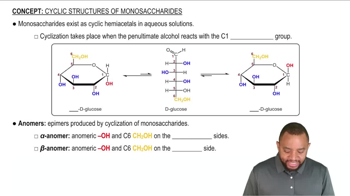
Carbohydrates can exist in linear or cyclic forms, with the cyclic form being more stable in aqueous solutions. The formation of a cyclic structure occurs through a reaction between the carbonyl group and a hydroxyl group, resulting in a hemiacetal or acetal. This process leads to the creation of a ring structure, which is crucial for determining the anomeric configuration of the carbohydrate.
Recommended video:
Guided course
2:49
Cyclic Structures of Monosaccharides Concept 1

D- and L- Configuration

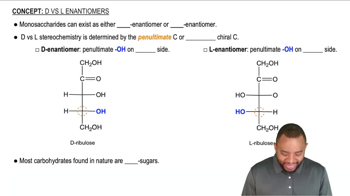
The D- and L- configuration of carbohydrates refers to the orientation of the hydroxyl group on the penultimate carbon (the second-to-last carbon) in the linear form of the sugar. If the hydroxyl group is on the right side in the Fischer projection, the sugar is classified as D; if it is on the left, it is classified as L. This configuration is important for identifying the specific anomer of a carbohydrate, as it influences the overall structure and properties of the molecule.
Recommended video:
Guided course
1:30
D vs L Enantiomers Concept 1