
Pearson+ LogoPearson+ Logo
Ch.1 Matter and Measurements
McMurry - Fundamentals of GOB 8th Edition
McMurry8th EditionFundamentals of GOBISBN: 9780134015187Not the one you use?Change textbook
Chapter 1, Problem 37

Name and describe the three states of matter.

Verified step by step guidance
1
Step 1: Define the three states of matter: solid, liquid, and gas. These are the physical forms in which matter can exist, depending on temperature and pressure conditions.
Step 2: Describe the solid state: In a solid, particles are closely packed together in a fixed arrangement. Solids have a definite shape and volume because the particles vibrate in place but do not move freely.
Step 3: Describe the liquid state: In a liquid, particles are still close together but not in a fixed arrangement. Liquids have a definite volume but take the shape of their container because the particles can move past one another.
Step 4: Describe the gas state: In a gas, particles are far apart and move freely. Gases have neither a definite shape nor a definite volume, as they expand to fill the container they are in.
Step 5: Summarize the differences: The key differences between the states of matter are the arrangement and movement of particles, which determine their shape and volume properties.

Verified video answer for a similar problem:

This video solution was recommended by our tutors as helpful for the problem above.
Video duration:
2m
Was this helpful?

Key Concepts

Here are the essential concepts you must grasp in order to answer the question correctly.

Solid

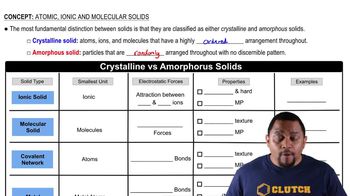
A solid is a state of matter characterized by a fixed shape and volume. The particles in a solid are closely packed together and vibrate in place, which gives solids their rigidity. Examples include ice, wood, and metals. Solids do not flow and maintain their shape unless subjected to sufficient force.
Recommended video:
Guided course
04:14
Atomic, Ionic and Molecular Solids Concept 1

Liquid

A liquid is a state of matter that has a definite volume but takes the shape of its container. The particles in a liquid are less tightly packed than in a solid, allowing them to move freely and slide past one another. This property enables liquids to flow and adapt to the shape of their surroundings. Common examples include water, oil, and alcohol.
Recommended video:
Guided course
1:16
Triacylglycerols Example 2

Gas

A gas is a state of matter that has neither a fixed shape nor a fixed volume. The particles in a gas are far apart and move rapidly in all directions, which allows gases to expand and fill any available space. This state of matter is highly compressible and can be observed in everyday examples like air, helium, and carbon dioxide.
Recommended video:
Guided course
00:47
Gas Stoichiometry Concept 1