Pearson+ LogoPearson+ Logo
Ch.10 Acids and Bases
McMurry - Fundamentals of GOB 8th Edition
McMurry8th EditionFundamentals of GOBISBN: 9780134015187Not the one you use?Change textbook
Chapter 10, Problem 99c

The dissociation of water into H3O+ and OH ions depends on temperature. At 0 °C the [H3O+] = 3.38 x 10⁻⁸ M, at 25 °C the [H3O+] = 1.00 x 10⁻⁷ M, and at 50 °C the [H3O+] = 2.34 x 10⁻⁷ M.
c. Is the dissociation of water endothermic or exothermic?

Verified step by step guidance
1
Step 1: Understand the relationship between temperature and the dissociation of water. The dissociation of water into H₃O⁺ and OH⁻ ions is influenced by temperature, and the equilibrium constant (Kw) increases as temperature increases.
Step 2: Recall the principle of Le Chatelier's Principle. If a reaction is endothermic, increasing temperature will favor the forward reaction (more dissociation). If a reaction is exothermic, increasing temperature will favor the reverse reaction (less dissociation).
Step 3: Analyze the data provided. At higher temperatures (25 °C and 50 °C), the concentration of H₃O⁺ increases compared to lower temperatures (0 °C). This indicates that the dissociation of water is favored as temperature increases.
Step 4: Connect the observation to thermodynamics. Since the dissociation of water is favored at higher temperatures, this suggests that the process absorbs heat, which is characteristic of an endothermic reaction.
Step 5: Conclude that the dissociation of water is endothermic based on the increase in [H₃O⁺] with temperature, consistent with the absorption of heat during the dissociation process.

Verified video answer for a similar problem:

This video solution was recommended by our tutors as helpful for the problem above.
Video duration:
2m
Was this helpful?

Key Concepts

Here are the essential concepts you must grasp in order to answer the question correctly.

Dissociation of Water

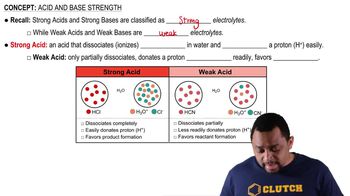
The dissociation of water refers to the process where water (H₂O) breaks down into hydronium (H₃O⁺) and hydroxide (OH⁻) ions. This equilibrium is influenced by temperature, as changes in temperature can shift the concentrations of these ions in solution. Understanding this process is crucial for analyzing how temperature affects the acidity and basicity of water.
Recommended video:
Guided course
02:06
Acid and Base Strength Concept 1

Endothermic vs. Exothermic Reactions

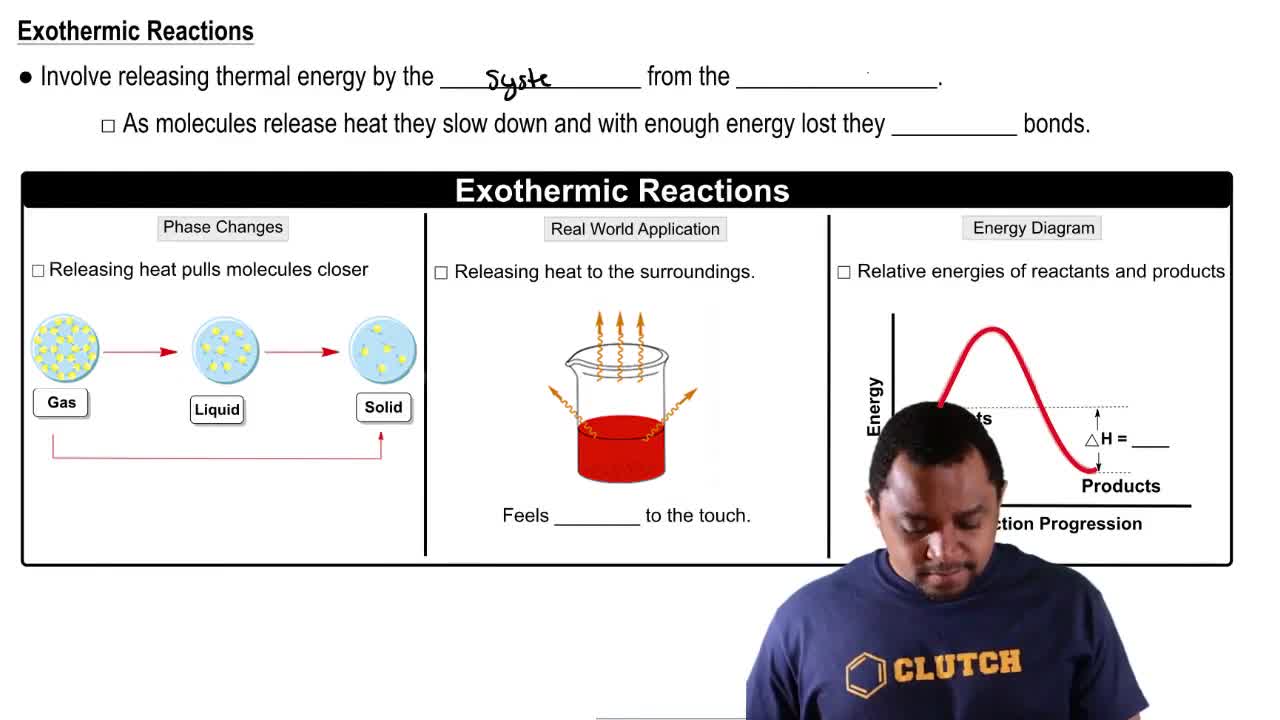
Endothermic reactions absorb heat from their surroundings, leading to a decrease in temperature, while exothermic reactions release heat, resulting in an increase in temperature. The classification of a reaction as endothermic or exothermic can be determined by observing temperature changes during the reaction. This concept is essential for understanding the thermal dynamics of the dissociation of water.
Recommended video:
Guided course
02:38
Endothermic & Exothermic Reactions

Temperature Dependence of Equilibrium

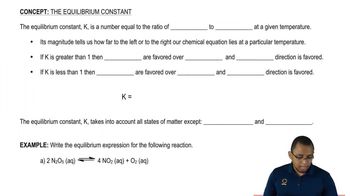
The temperature dependence of equilibrium states that the position of equilibrium in a chemical reaction can shift with changes in temperature, as described by Le Chatelier's principle. For the dissociation of water, an increase in temperature typically favors the formation of products (H₃O⁺ and OH⁻), indicating that the reaction is endothermic. This principle helps in predicting how temperature variations affect the dissociation process.
Recommended video:
Guided course
02:50
The Equilibrium Constant Concept 1