Pearson+ LogoPearson+ Logo
Ch.5 Classification & Balancing of Chemical Reactions
McMurry - Fundamentals of GOB 8th Edition
McMurry8th EditionFundamentals of GOBISBN: 9780134015187Not the one you use?Change textbook
Chapter 5, Problem 27

Which of the following equations are balanced? Balance those that need it.
a. CaC2 + 2 H2O → Ca(OH)2 +C2H2
b. C2H8N2 + 2 N2O4 → 2 N2 + 2 CO2 + 4 H2O
c. 3 MgO + 2 Fe → Fe2O3 + 3 Mg
d. N2O → N2 + O2

Verified step by step guidance
1
Step 1: Understand the concept of a balanced chemical equation. A balanced equation has the same number of each type of atom on both sides of the reaction arrow. This ensures the law of conservation of mass is upheld.
Step 2: Analyze equation (a): CaC₂ + 2 H₂O → Ca(OH)₂ + C₂H₂. Count the atoms of each element on both sides. Calcium (Ca), carbon (C), hydrogen (H), and oxygen (O) should all be balanced. Verify if the number of atoms matches on both sides.
Step 3: Analyze equation (b): C₂H₈N₂ + 2 N₂O₄ → 2 N₂ + 2 CO₂ + 4 H₂O. Count the atoms of carbon (C), hydrogen (H), nitrogen (N), and oxygen (O) on both sides. Adjust coefficients if necessary to balance the equation.
Step 4: Analyze equation (c): 3 MgO + 2 Fe → Fe₂O₃ + 3 Mg. Count the atoms of magnesium (Mg), oxygen (O), and iron (Fe) on both sides. Adjust coefficients if needed to ensure the equation is balanced.
Step 5: Analyze equation (d): N₂O → N₂ + O₂. Count the atoms of nitrogen (N) and oxygen (O) on both sides. Adjust coefficients if necessary to balance the equation. Remember that diatomic molecules like O₂ and N₂ must be considered in their molecular form.

Verified video answer for a similar problem:

This video solution was recommended by our tutors as helpful for the problem above.
Video duration:
3m
Was this helpful?

Key Concepts

Here are the essential concepts you must grasp in order to answer the question correctly.

Chemical Equation

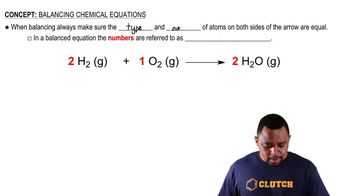
A chemical equation represents a chemical reaction using symbols and formulas. It shows the reactants on the left side and the products on the right, separated by an arrow. Balancing a chemical equation ensures that the number of atoms for each element is the same on both sides, adhering to the law of conservation of mass.
Recommended video:
Guided course
01:32
Balancing Chemical Equations (Simplified) Concept 1

Balancing Equations

Balancing equations involves adjusting the coefficients of the reactants and products to ensure that the total number of atoms of each element is equal on both sides of the equation. This process may require trial and error, and it is essential for accurately representing the quantities involved in a chemical reaction.
Recommended video:
Guided course
01:32
Balancing Chemical Equations (Simplified) Concept 1

Stoichiometry

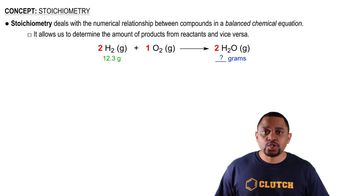
Stoichiometry is the study of the quantitative relationships between the substances involved in a chemical reaction. It allows chemists to calculate the amounts of reactants needed and products formed, based on balanced equations. Understanding stoichiometry is crucial for predicting the outcomes of reactions and for practical applications in laboratory settings.
Recommended video:
Guided course
01:16
Stoichiometry
Related Practice
Textbook Question

An aqueous solution of a cation (represented as blue spheres in the diagram) is allowed to mix with a solution of an anion (represented as green spheres) and the following result is obtained:

Which combinations of cation and anion, chosen from the following lists, are compatible with the observed results? Explain.

Cations: Na+, Ca2+, Ag+, Ni2+

Anions: Cl, CO23–, CrO42–, NO3

1883
views
Textbook Question

What is meant by the term 'balanced equation'?

2437
views
Textbook Question

Why is it not possible to balance an equation by changing the subscript on a substance, say from H2O to H2O2?

2219
views
Textbook Question

When sodium metal is placed in water, the following change occurs: Sodium, Na(s) + Water, H2O(l) → Hydrogen, H2(g) + Sodium hydroxide, NaOH(aq)

a. Identify the reactants and products and their physical states

2255
views
Textbook Question

In each of the following, tell whether the substance gains electrons or loses electrons in a redox reaction:

a. An oxidizing agent

b. A reducing agent

c. A substance undergoing oxidation

d. A substance undergoing reduction

1517
views
Textbook Question

High temperature combustion processes, such as in combustion engines and coal-fired power plants, can result in the reaction of nitrogen and sulfur with oxygen to form nitrogen oxides (NO𝓍) and sulfur oxides (SO𝓍), where x can vary. These NO𝓍 and SO𝓍 compounds subsequently undergo further reaction in the atmosphere to create acidic compounds that contribute to acid rain.

a. Do some research to determine the common products that are formed (i.e., what are the values of x) for the reactions of N and S with oxygen. Write balanced equations for these reactions.

1616
views