Pearson+ LogoPearson+ Logo
Ch.7 Chemical Reactions: Energy, Rate and Equilibrium
McMurry - Fundamentals of GOB 8th Edition
McMurry8th EditionFundamentals of GOBISBN: 9780134015187Not the one you use?Change textbook
Chapter 7, Problem 12a

Do the following reactions favor reactants or products at equilibrium? Give relative concentrations at equilibrium.
a. Sucrose(aq) + H2O(l) ⇌ Glucose(aq) + Fructose(aq) K = 1.4 × 10⁵

Verified step by step guidance
1
Step 1: Understand the equilibrium constant (K). The equilibrium constant (K) is a measure of the extent to which a reaction proceeds to form products. A large K value (K >> 1) indicates that the reaction strongly favors the formation of products at equilibrium, while a small K value (K << 1) indicates that the reaction favors the reactants.
Step 2: Analyze the given K value. In this case, K = 1.4 × 10^5, which is a very large number. This suggests that the reaction strongly favors the formation of products (Glucose and Fructose) at equilibrium.
Step 3: Predict the relative concentrations at equilibrium. Since the reaction favors the products, the concentrations of Glucose and Fructose will be much higher than the concentration of Sucrose at equilibrium. The concentration of water (H2O) is typically considered constant in aqueous solutions and does not significantly change.
Step 4: Write the equilibrium expression for the reaction. The equilibrium constant expression is: K = [Glucose][Fructose][Sucrose]. A large K value indicates that the numerator (product concentrations) will be much larger than the denominator (reactant concentration).
Step 5: Conclude the reaction's favorability. Based on the large K value, the reaction strongly favors the products (Glucose and Fructose) at equilibrium, and their concentrations will be significantly higher compared to the concentration of Sucrose.

Verified video answer for a similar problem:

This video solution was recommended by our tutors as helpful for the problem above.
Video duration:
6m
Was this helpful?

Key Concepts

Here are the essential concepts you must grasp in order to answer the question correctly.

Chemical Equilibrium

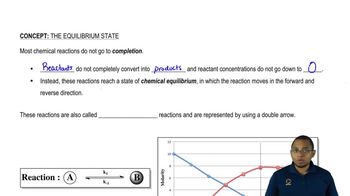
Chemical equilibrium occurs when the rates of the forward and reverse reactions are equal, resulting in constant concentrations of reactants and products. In this state, the system is dynamic, meaning that reactions continue to occur, but there is no net change in concentration. Understanding this concept is crucial for analyzing the favorability of reactants or products in a given reaction.
Recommended video:
Guided course
03:42
Chemical Equilibrium Concept 1

Equilibrium Constant (K)

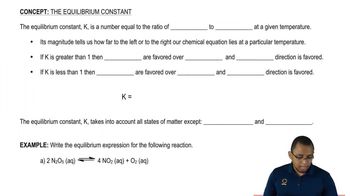
The equilibrium constant (K) quantifies the ratio of the concentrations of products to reactants at equilibrium for a given reaction at a specific temperature. A large K value, such as 1.4 x 10^5, indicates that at equilibrium, the concentration of products is significantly higher than that of reactants, suggesting that the reaction favors the formation of products.
Recommended video:
Guided course
02:50
The Equilibrium Constant Concept 1

Le Chatelier's Principle

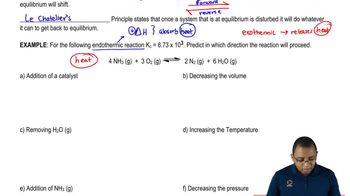
Le Chatelier's Principle states that if a system at equilibrium is subjected to a change in concentration, temperature, or pressure, the system will adjust to counteract that change and restore a new equilibrium. This principle helps predict how changes in conditions can affect the position of equilibrium, further informing whether reactants or products are favored.