Pearson+ LogoPearson+ Logo
Ch.7 Chemical Reactions: Energy, Rate and Equilibrium
McMurry - Fundamentals of GOB 8th Edition
McMurry8th EditionFundamentals of GOBISBN: 9780134015187Not the one you use?Change textbook
Chapter 7, Problem 14a

The following diagrams represent two similar reactions that have achieved equilibrium:
<IMAGE>
a. Write the expression for the equilibrium constant for each reaction.

Verified step by step guidance
1
Identify the general form of the equilibrium constant expression. For a reaction of the form \( aA + bB \rightleftharpoons cC + dD \), the equilibrium constant \( K_{eq} \) is expressed as \( K_{eq} = \frac{[C]^c[D]^d}{[A]^a[B]^b} \), where the square brackets represent the concentrations of the species at equilibrium, and the exponents correspond to their stoichiometric coefficients.
Examine the first reaction diagram and determine the chemical equation it represents. Identify the reactants and products, as well as their stoichiometric coefficients.
Write the equilibrium constant expression for the first reaction using the general form \( K_{eq} = \frac{[products]}{[reactants]} \), substituting the appropriate species and their coefficients.
Repeat the process for the second reaction diagram. Determine the chemical equation, identify the reactants and products, and their stoichiometric coefficients.
Write the equilibrium constant expression for the second reaction using the same general form \( K_{eq} = \frac{[products]}{[reactants]} \), ensuring the correct species and coefficients are used.

Verified video answer for a similar problem:

This video solution was recommended by our tutors as helpful for the problem above.
Video duration:
1m
Was this helpful?

Key Concepts

Here are the essential concepts you must grasp in order to answer the question correctly.

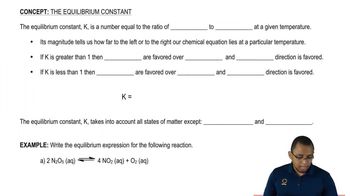
Equilibrium Constant (K)

The equilibrium constant (K) is a numerical value that expresses the ratio of the concentrations of products to reactants at equilibrium for a given chemical reaction. It is calculated using the formula K = [products]^[coefficients] / [reactants]^[coefficients], where the brackets denote concentration. A large K value indicates a reaction that favors products, while a small K value suggests a preference for reactants.
Recommended video:
Guided course
02:50
The Equilibrium Constant Concept 1

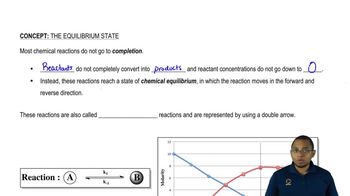
Chemical Equilibrium

Chemical equilibrium occurs when the rates of the forward and reverse reactions are equal, resulting in constant concentrations of reactants and products over time. At this state, the system is dynamic, meaning that reactions continue to occur, but there is no net change in the concentrations. Understanding this concept is crucial for writing equilibrium expressions accurately.
Recommended video:
Guided course
03:42
Chemical Equilibrium Concept 1

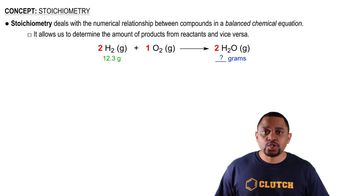
Stoichiometry

Stoichiometry is the study of the quantitative relationships between the amounts of reactants and products in a chemical reaction. It involves using the coefficients from a balanced chemical equation to determine the proportions of substances involved. This concept is essential for formulating the equilibrium constant expression, as the coefficients dictate how concentrations are raised to powers in the K expression.
Recommended video:
Guided course
01:16
Stoichiometry