Pearson+ LogoPearson+ Logo
Ch.7 Chemical Reactions: Energy, Rate and Equilibrium
McMurry - Fundamentals of GOB 8th Edition
McMurry8th EditionFundamentals of GOBISBN: 9780134015187Not the one you use?Change textbook
Chapter 7, Problem 12c

Do the following reactions favor reactants or products at equilibrium? Give relative concentrations at equilibrium.
c. Fe2O3(s) + 3 CO(g) ⇌ 2 Fe(s) + 3 CO2(g) K (at 727 °C) = 24.2

Verified step by step guidance
1
Identify the equilibrium constant (K) provided in the problem. Here, K = 24.2 at 727 °C. The equilibrium constant indicates the ratio of the concentrations of products to reactants at equilibrium.
Interpret the value of K. Since K > 1 (24.2 is greater than 1), the reaction favors the formation of products at equilibrium. This means that the concentration of products will be higher than the concentration of reactants at equilibrium.
Recognize the states of matter in the reaction. Solids (Fe2O3 and Fe) do not appear in the equilibrium expression because their concentrations are constant and do not affect the equilibrium position.
Write the equilibrium expression for the reaction: K = [CO2]3[CO]3. This expression only includes the gaseous species CO and CO2.
Conclude that at equilibrium, the concentration of CO2 (a product) will be relatively higher than the concentration of CO (a reactant), as the reaction favors the products due to the large K value.

Verified video answer for a similar problem:

This video solution was recommended by our tutors as helpful for the problem above.
Video duration:
3m
Was this helpful?

Key Concepts

Here are the essential concepts you must grasp in order to answer the question correctly.

Chemical Equilibrium

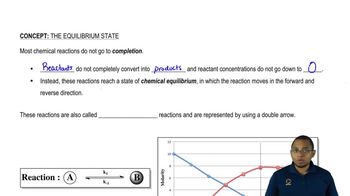
Chemical equilibrium occurs when the rates of the forward and reverse reactions are equal, resulting in constant concentrations of reactants and products. At this point, the system is in a state of balance, and the concentrations of all species remain unchanged over time. Understanding this concept is crucial for analyzing how changes in conditions affect the position of equilibrium.
Recommended video:
Guided course
03:42
Chemical Equilibrium Concept 1

Equilibrium Constant (K)

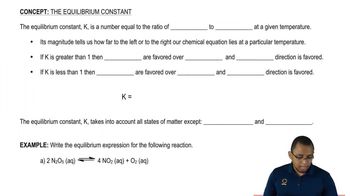
The equilibrium constant (K) quantifies the ratio of the concentrations of products to reactants at equilibrium for a given reaction at a specific temperature. A large K value (greater than 1) indicates that products are favored at equilibrium, while a small K value (less than 1) suggests that reactants are favored. In this case, K = 24.2 implies a significant preference for the formation of products.
Recommended video:
Guided course
02:50
The Equilibrium Constant Concept 1

Le Chatelier's Principle

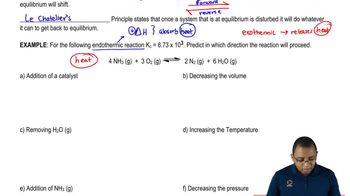
Le Chatelier's Principle states that if a dynamic equilibrium is disturbed by changing the conditions, the system will adjust to counteract the change and restore a new equilibrium. This principle helps predict how changes in concentration, pressure, or temperature will affect the position of equilibrium, providing insight into the relative concentrations of reactants and products.