
Textbook Question
The following diagrams represent two similar reactions that have achieved equilibrium:
<IMAGE>
a. Write the expression for the equilibrium constant for each reaction.
1787
views

 Verified step by step guidance
 09:34
09:34
 02:50
02:50 02:38
02:38The following diagrams represent two similar reactions that have achieved equilibrium:
<IMAGE>
a. Write the expression for the equilibrium constant for each reaction.
The following diagrams represent two similar reactions that have achieved equilibrium:
<IMAGE>
b. Calculate the value for the equilibrium constant for each reaction.
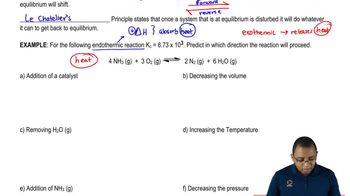
What effect do the listed changes have on the position of the equilibrium in the reaction of carbon with hydrogen?
C(s) + 2 H2(g) ⇌ CH4(g) ∆H = -18 kcal/mol (-75kJ/mol)
b. Increasing pressure by decreasing volume
What effect do the listed changes have on the position of the equilibrium in the reaction of carbon with hydrogen?
C(s) + 2 H2(g) ⇌ CH4(g) ∆H = -18 kcal/mol (-75kJ/mol)
c. Allowing CH4 to escape continuously from the reaction vessel
Do the following reactions favor reactants or products at equilibrium? Give relative concentrations at equilibrium.
c. Fe2O3(s) + 3 CO(g) ⇌ 2 Fe(s) + 3 CO2(g) K (at 727 °C) = 24.2
What effect do the listed changes have on the position of the equilibrium in the reaction of carbon with hydrogen?
C(s) + 2 H2(g) ⇌ CH4(g) ∆H = -18 kcal/mol (-75kJ/mol)
a. Increasing temperature