
Textbook Question
List four common units for measuring pressure.
2522
views

 Verified step by step guidance
 00:48
00:48
 00:38
00:38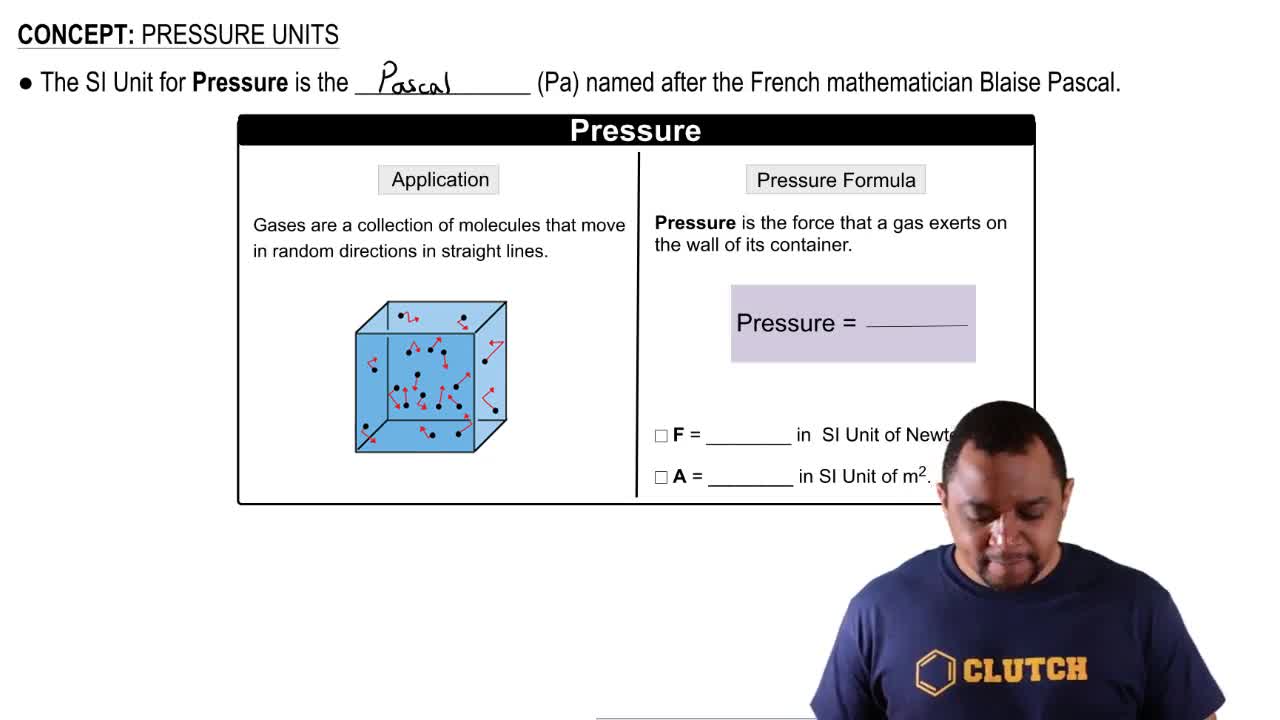 01:15
01:15List four common units for measuring pressure.
A local weather station reports the barometric pressure as 29.5 inHg (inches of Hg). Convert this pressure to torr and to atm.
Assume that you have a sample of gas at 350 K in a sealed container, as represented in part (a). Which of the drawings (b)–(d) represents the gas after the temperature is lowered from 350 K to 150 K and if the gas has a boiling point of 200 K? Which drawing represents the gas at 150 K if the gas has a boiling point of 100 K?
<IMAGE>
Would you expect the boiling points to increase or decrease in the following series? Explain.
a. Kr, Ar, Ne
Compare the ∆Hvap values for water, isopropyl alcohol, ether, and ammonia, and order them from lowest to highest. Explain the rank order based on intermolecular attractive forces.
The change of state from liquid H2O to gaseous H2O has ∆H = +9.72 kcal/mol(+40.7 kJ/mol) and ∆S = -26.1 cal/(mol • K) [-109 J/(mol •K)].
b. What are the values of ∆H and ∆S (in kcal/mol and kJ/mol) for the change from gaseous to liquid H2O?