Pearson+ LogoPearson+ Logo
Ch.8 Gases, Liquids and Solids
McMurry - Fundamentals of GOB 8th Edition
McMurry8th EditionFundamentals of GOBISBN: 9780134015187Not the one you use?Change textbook
Chapter 8, Problem 25

Compare the ∆Hvap values for water, isopropyl alcohol, ether, and ammonia, and order them from lowest to highest. Explain the rank order based on intermolecular attractive forces.

Verified step by step guidance
1
Step 1: Understand the concept of ∆Hvap (enthalpy of vaporization). It is the amount of energy required to convert one mole of a liquid into a gas at constant temperature and pressure. Substances with stronger intermolecular forces will have higher ∆Hvap values because more energy is needed to overcome these forces.
Step 2: Identify the types of intermolecular forces present in each substance. Water (H₂O) exhibits hydrogen bonding, dipole-dipole interactions, and London dispersion forces. Isopropyl alcohol (C₃H₈O) also exhibits hydrogen bonding, dipole-dipole interactions, and London dispersion forces, but its hydrogen bonding is weaker than water due to its molecular structure. Ether (C₂H₆O) primarily exhibits dipole-dipole interactions and London dispersion forces, as it lacks the -OH group necessary for hydrogen bonding. Ammonia (NH₃) exhibits hydrogen bonding, dipole-dipole interactions, and London dispersion forces, but its hydrogen bonding is weaker than water due to fewer hydrogen bonds per molecule.
Step 3: Compare the strength of intermolecular forces. Water has the strongest hydrogen bonding due to its ability to form multiple hydrogen bonds per molecule, followed by ammonia, which can form fewer hydrogen bonds. Isopropyl alcohol has weaker hydrogen bonding than water and ammonia due to its bulkier structure, which limits hydrogen bond formation. Ether has the weakest intermolecular forces because it lacks hydrogen bonding entirely.
Step 4: Predict the ∆Hvap ranking based on the strength of intermolecular forces. Substances with stronger intermolecular forces will have higher ∆Hvap values. Therefore, the order from lowest to highest ∆Hvap should be: ether < isopropyl alcohol < ammonia < water.
Step 5: Summarize the reasoning. The rank order is based on the types and strengths of intermolecular forces present in each substance. Water has the highest ∆Hvap due to its strong hydrogen bonding, followed by ammonia, which has weaker hydrogen bonding. Isopropyl alcohol has weaker hydrogen bonding than ammonia, and ether has the lowest ∆Hvap because it lacks hydrogen bonding and relies only on weaker dipole-dipole and London dispersion forces.

Verified video answer for a similar problem:

This video solution was recommended by our tutors as helpful for the problem above.
Video duration:
2m
Was this helpful?

Key Concepts

Here are the essential concepts you must grasp in order to answer the question correctly.

Enthalpy of Vaporization (∆Hvap)

Enthalpy of vaporization (∆Hvap) is the amount of energy required to convert a unit mass of a liquid into vapor at constant temperature and pressure. It reflects the strength of intermolecular forces within the liquid; higher ∆Hvap values indicate stronger forces that need to be overcome for vaporization. This concept is crucial for comparing the volatility of different substances.
Recommended video:
Guided course
02:30
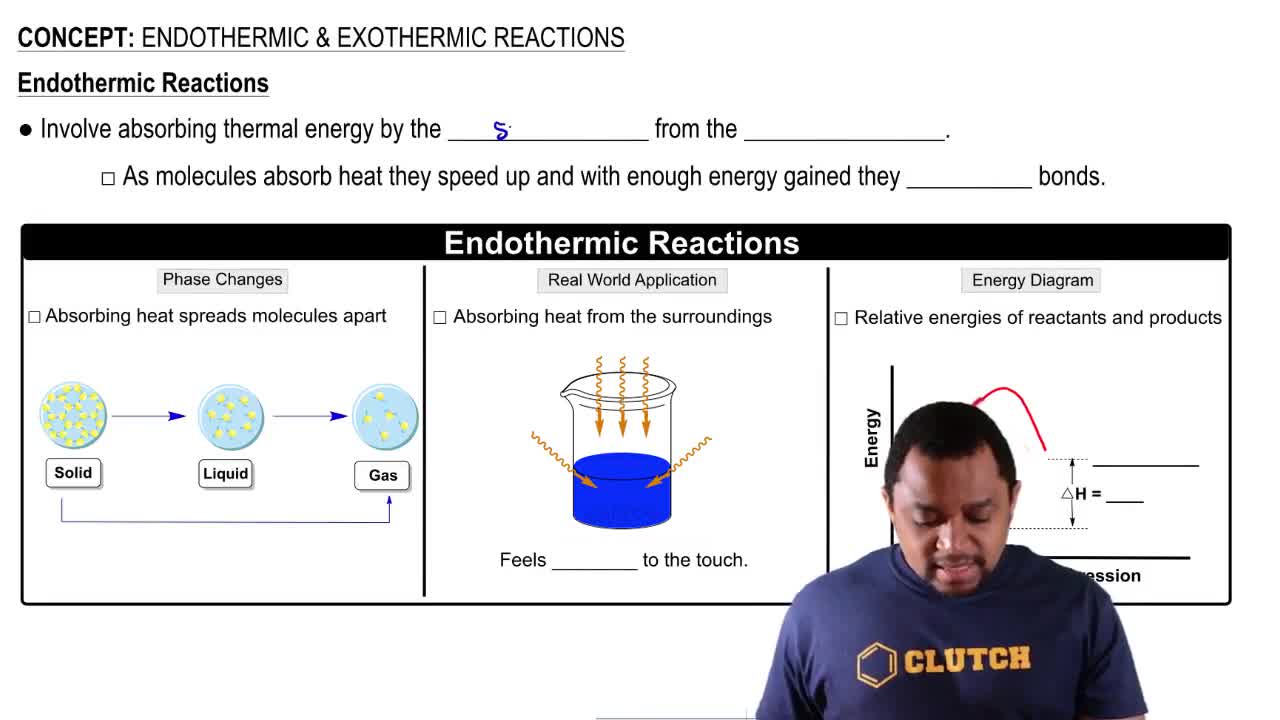
Endothermic & Exothermic Reactions

Intermolecular Forces

Intermolecular forces are the attractive forces between molecules that influence physical properties such as boiling points and vapor pressures. These forces include hydrogen bonding, dipole-dipole interactions, and London dispersion forces. The strength and type of these forces determine the rank order of ∆Hvap values among substances, as stronger forces result in higher energy requirements for vaporization.
Recommended video:
Guided course
01:59
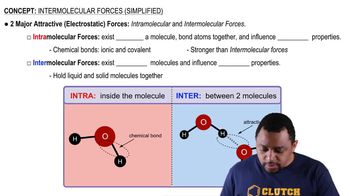
Intermolecular Forces (Simplified) Concept 1

Comparative Volatility

Comparative volatility refers to the tendency of a substance to vaporize compared to others, which is directly related to its ∆Hvap and intermolecular forces. Substances with lower ∆Hvap values are more volatile, meaning they evaporate more easily. Understanding this concept allows for the ranking of substances like water, isopropyl alcohol, ether, and ammonia based on their vaporization characteristics.
Recommended video:
Guided course
02:51
The Colligative Properties Concept 2