
Pearson+ LogoPearson+ Logo
Ch.9 Solutions
McMurry - Fundamentals of GOB 8th Edition
McMurry8th EditionFundamentals of GOBISBN: 9780134015187Not the one you use?Change textbook
Chapter 9, Problem 26b

A typical oral rehydration solution (ORS) for infants contains 90 mEq/L Na+, 20 mEq/L K+, 110 mEq/L Cl and 2.0% (m/v) glucose (MW = 180g/mol).
b. What is the osmolarity of the solution, and how does it compare with the osmolarity of blood plasma?

Verified step by step guidance
1
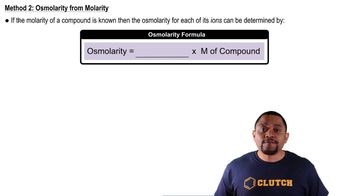
Step 1: Understand the concept of osmolarity. Osmolarity is the total concentration of solute particles in a solution. It is calculated by summing up the molar concentrations of all solutes, taking into account the number of particles each solute dissociates into in solution.
Step 2: Convert the given concentrations of ions (Na⁺, K⁺, Cl⁻) from mEq/L to mol/L. Use the relationship: \( \text{mEq/L} = \text{mmol/L} \), and divide by 1000 to convert to mol/L. For example, \( \text{[Na⁺]} = \frac{90}{1000} \text{ mol/L} \). Repeat this for K⁺ and Cl⁻.
Step 3: Account for dissociation of solutes. Sodium (Na⁺), potassium (K⁺), and chloride (Cl⁻) are already in their ionic forms, so their contributions to osmolarity are equal to their molar concentrations. Add these contributions together to get the total osmolarity from ions.
Step 4: Calculate the molar concentration of glucose. Use the given mass/volume percentage (2.0% m/v) and the molar mass of glucose (180 g/mol). First, convert 2.0% m/v to grams per liter (2.0 g/100 mL = 20 g/L). Then, divide by the molar mass: \( \text{[Glucose]} = \frac{20}{180} \text{ mol/L} \). Since glucose does not dissociate, its contribution to osmolarity is equal to its molar concentration.
Step 5: Add the contributions from ions and glucose to find the total osmolarity of the solution. Compare this value to the typical osmolarity of blood plasma, which is approximately 275-300 mOsm/L, to determine how the ORS solution compares in terms of osmolarity.

Verified video answer for a similar problem:

This video solution was recommended by our tutors as helpful for the problem above.
Video duration:
3m
Was this helpful?

Key Concepts

Here are the essential concepts you must grasp in order to answer the question correctly.

Osmolarity

Osmolarity is a measure of the total concentration of solute particles in a solution. It is expressed in osmoles per liter (osmol/L) and is crucial for understanding how solutions affect cell hydration and fluid balance. In the context of ORS, osmolarity helps determine how effectively the solution can rehydrate an infant by comparing the concentration of electrolytes and glucose.
Recommended video:

Electrolytes

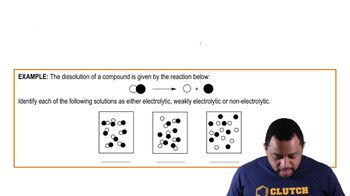
Electrolytes are minerals in the body that carry an electric charge and are essential for various physiological functions, including maintaining fluid balance, nerve function, and muscle contraction. In the ORS, sodium (Na⁺), potassium (K⁺), and chloride (Cl⁻) are key electrolytes that contribute to the osmolarity and effectiveness of the solution in treating dehydration.
Recommended video:
Guided course
01:07
Electrolytes (Simplified) Example 3

Comparison with Blood Plasma

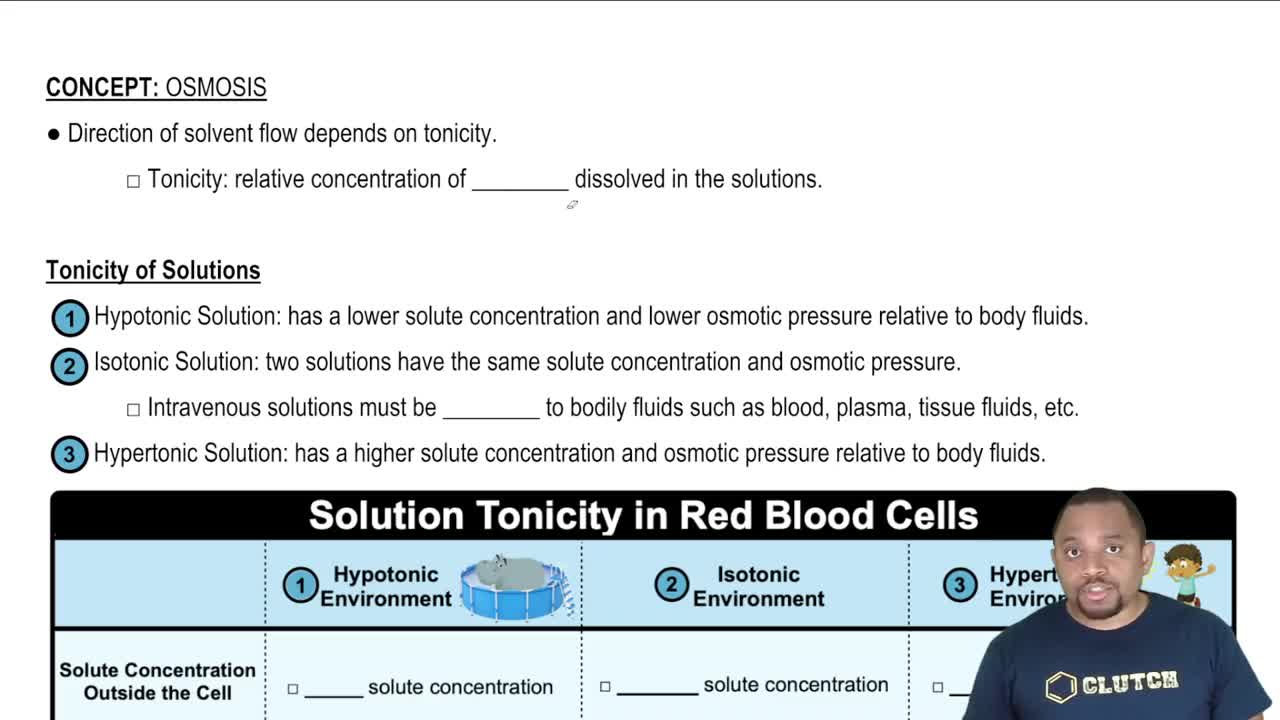
Blood plasma has a typical osmolarity of about 280-300 mOsm/L, which is important for maintaining homeostasis in the body. Comparing the osmolarity of the ORS with that of blood plasma helps assess whether the solution is isotonic, hypotonic, or hypertonic, influencing its suitability for rehydration therapy in infants. An isotonic solution is generally preferred to avoid complications such as cellular swelling or shrinkage.
Recommended video:
Guided course
04:29
Osmosis Concept 3