
An isotonic solution must be approximately 0.30 osmol/L. How much KCl is needed to prepare 175 mL of an isotonic solution?
Ammonia, NH3, is very soluble in water (51.8 g/L at 20 °C and 760 mmHg).
a. Show how NH3 can hydrogen bond to water.
Verified step by step guidance
Verified video answer for a similar problem:
Key Concepts
Hydrogen Bonding
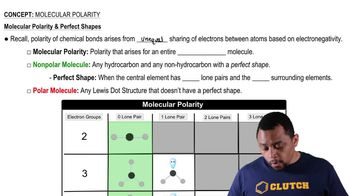
Polarity of Molecules
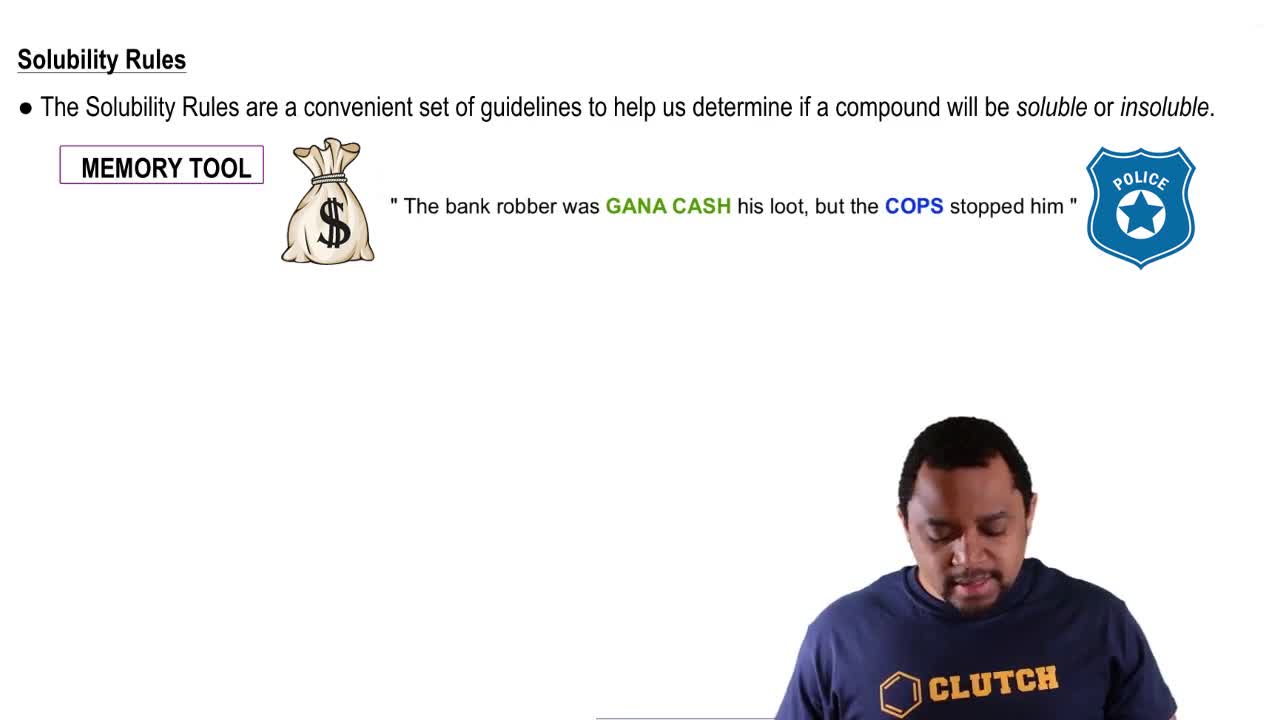
Solubility Principles
Uric acid, the principal constituent of some kidney stones, has the formula C5H4N4O3. In aqueous solution, the solubility of uric acid is only 0.067 g/L. Express this concentration in (m/v)%, in parts per million, and in molarity.
Emergency treatment of cardiac arrest victims sometimes involves injection of a calcium chloride solution directly into the heart muscle. How many grams of CaCl2 are administered in an injection of 5.0 mL of a 5.0% (m/v) solution? How many milliequivalents of Ca2+?
Cobalt(II) chloride, a blue solid, can absorb water from the air to form cobalt(II) chloride hexahydrate, a pink solid. The equilibrium is so sensitive to moisture in the air that CoCl2 is used as a humidity indicator.
a. Write a balanced equation for the equilibrium. Be sure to include water as a reactant to produce the hexahydrate.
How many milliliters of 0.150 M BaCl2 are needed to react completely with 35.0 mL of 0.200 M Na2SO4? How many grams of BaSO4 will be formed?
Many compounds are only partially dissociated into ions in aqueous solution. Trichloroacetic acid (CCl3CO2H), for instance, is partially dissociated in water according to the equation
CCl3CO2H(aq) → H+(aq) + CCl3CO2⁻ aq)
For a solution prepared by dissolving 1.00 mol of trichloroacetic acid in 1.00 kg of water, 36.0% of the trichloroacetic acid dissociates to form H+ and CCl3CO2⁻ ions.
a. What is the total concentration of dissolved ions and molecules in 1 kg of water?
