
Pearson+ LogoPearson+ Logo
Ch.9 Solutions
McMurry - Fundamentals of GOB 8th Edition
McMurry8th EditionFundamentals of GOBISBN: 9780134015187Not the one you use?Change textbook
Chapter 9, Problem 94

How many milliliters of 0.150 M BaCl2 are needed to react completely with 35.0 mL of 0.200 M Na2SO4? How many grams of BaSO4 will be formed?

Verified step by step guidance
1
Write the balanced chemical equation for the reaction: BaCl2(aq)+Na2SO4(aq)BaSO4(s)+2NaCl(aq). This shows a 1:1 molar ratio between BaCl₂ and Na₂SO₄, and BaSO₄ is the precipitate formed.
Calculate the moles of Na₂SO₄ using its molarity and volume: moles=M×V, where M is the molarity (0.200 M) and V is the volume in liters (35.0 mL converted to liters).
Using the 1:1 molar ratio from the balanced equation, determine the moles of BaCl₂ required to react with the calculated moles of Na₂SO₄.
Calculate the volume of 0.150 M BaCl₂ solution needed to provide the required moles of BaCl₂ using the formula: V=molesM, where M is the molarity of BaCl₂ (0.150 M).
Determine the mass of BaSO₄ formed using the moles of BaSO₄ (equal to the moles of Na₂SO₄ due to the 1:1 ratio) and the molar mass of BaSO₄. Use the formula: mass=moles×molarmass.

Verified video answer for a similar problem:

This video solution was recommended by our tutors as helpful for the problem above.
Video duration:
8m
Was this helpful?

Key Concepts

Here are the essential concepts you must grasp in order to answer the question correctly.

Stoichiometry

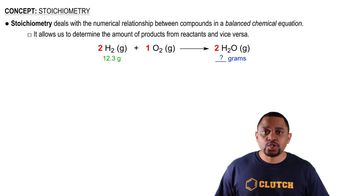
Stoichiometry is the branch of chemistry that deals with the quantitative relationships between reactants and products in a chemical reaction. It allows us to calculate the amounts of substances consumed and produced in a reaction based on balanced chemical equations. Understanding stoichiometry is essential for determining how much of one reactant is needed to completely react with another.
Recommended video:
Guided course
01:16
Stoichiometry

Molarity

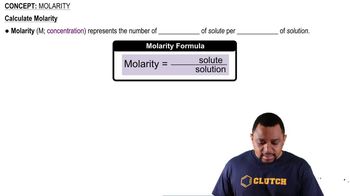
Molarity is a measure of concentration defined as the number of moles of solute per liter of solution. It is expressed in moles per liter (M) and is crucial for calculating how much of a substance is present in a given volume of solution. In this question, the molarity of BaCl₂ and Na₂SO₄ is used to determine the volume of BaCl₂ required for the reaction.
Recommended video:

Precipitation Reaction

A precipitation reaction occurs when two soluble salts react in solution to form an insoluble product, known as a precipitate. In this case, the reaction between BaCl₂ and Na₂SO₄ produces BaSO₄, which is insoluble in water. Understanding the formation of precipitates is important for predicting the products of the reaction and calculating the mass of the precipitate formed.
Recommended video:
Guided course
1:30
Alcohol Reactions: Dehydration Reactions Concept 1
Related Practice
Textbook Question

Emergency treatment of cardiac arrest victims sometimes involves injection of a calcium chloride solution directly into the heart muscle. How many grams of CaCl2 are administered in an injection of 5.0 mL of a 5.0% (m/v) solution? How many milliequivalents of Ca2+?

1142
views
Textbook Question

Ammonia, NH3, is very soluble in water (51.8 g/L at 20 °C and 760 mmHg).

a. Show how NH3 can hydrogen bond to water.

1986
views
Textbook Question

Cobalt(II) chloride, a blue solid, can absorb water from the air to form cobalt(II) chloride hexahydrate, a pink solid. The equilibrium is so sensitive to moisture in the air that CoCl2 is used as a humidity indicator.

a. Write a balanced equation for the equilibrium. Be sure to include water as a reactant to produce the hexahydrate.

1985
views
Textbook Question

Many compounds are only partially dissociated into ions in aqueous solution. Trichloroacetic acid (CCl3CO2H), for instance, is partially dissociated in water according to the equation

CCl3CO2H(aq) → H+(aq) + CCl3CO2⁻ aq)

For a solution prepared by dissolving 1.00 mol of trichloroacetic acid in 1.00 kg of water, 36.0% of the trichloroacetic acid dissociates to form H+ and CCl3CO2⁻ ions.

a. What is the total concentration of dissolved ions and molecules in 1 kg of water?

1627
views
Textbook Question

Many compounds are only partially dissociated into ions in aqueous solution. Trichloroacetic acid (CCl3CO2H), for instance, is partially dissociated in water according to the equation

CCl3CO2H(aq) → H+(aq) + CCl3CO2⁻ aq)

For a solution prepared by dissolving 1.00 mol of trichloroacetic acid in 1.00 kg of water, 36.0% of the trichloroacetic acid dissociates to form H+ and CCl3CO2⁻ ions.

b. What is the freezing point of this solution? (The freezing point of 1 kg of water is lowered 1.86 °C for each mole of solute particles.)

1415
views
Textbook Question

Hyperbaric chambers, which provide high pressures (up to 6 atm) of either air or pure oxygen, are used to treat a variety of conditions, ranging from decompression sickness in deep-sea divers to carbon monoxide poisoning. Look up the solubility of O2, N2, CO, and CO2 in water at standard temperature and pressure (1 atm, 25 °C).

a. Explain the trends in relative solubility for these gases.

1776
views