
Pearson+ LogoPearson+ Logo
Ch.9 Solutions
McMurry - Fundamentals of GOB 8th Edition
McMurry8th EditionFundamentals of GOBISBN: 9780134015187Not the one you use?Change textbook
Chapter 9, Problem 85

Uric acid, the principal constituent of some kidney stones, has the formula C5H4N4O3. In aqueous solution, the solubility of uric acid is only 0.067 g/L. Express this concentration in (m/v)%, in parts per million, and in molarity.

Verified step by step guidance
1
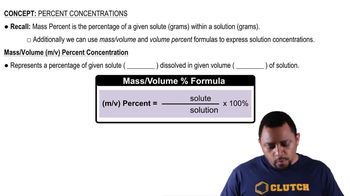
To express the concentration in (m/v)%: (m/v)% is defined as the mass of solute (in grams) per 100 mL of solution. Start by noting that the solubility of uric acid is 0.067 g/L. Convert this to grams per 100 mL by dividing by 10, since 1 L = 1000 mL.
To express the concentration in parts per million (ppm): ppm is defined as the mass of solute (in grams) per 1,000,000 grams of solution. Since 1 L of water has a mass of approximately 1000 g, use the given solubility (0.067 g/L) and multiply it by 1,000 to convert to ppm.
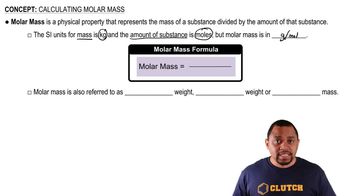
To express the concentration in molarity: Molarity (M) is defined as moles of solute per liter of solution. First, calculate the molar mass of uric acid (C₅H₄N₄O₃) by summing the atomic masses of its constituent atoms: Carbon (C), Hydrogen (H), Nitrogen (N), and Oxygen (O). Use the periodic table to find the atomic masses: C = 12.01 g/mol, H = 1.008 g/mol, N = 14.01 g/mol, O = 16.00 g/mol.
After calculating the molar mass of uric acid, convert the given solubility (0.067 g/L) into moles per liter by dividing the mass of uric acid (0.067 g) by its molar mass (calculated in the previous step).
Summarize the results: Report the concentration in (m/v)%, ppm, and molarity using the calculations from the previous steps. Ensure that the units are clearly labeled for each concentration format.

Verified video answer for a similar problem:

This video solution was recommended by our tutors as helpful for the problem above.
Video duration:
8m
Was this helpful?

Key Concepts

Here are the essential concepts you must grasp in order to answer the question correctly.

Concentration Units

Concentration can be expressed in various units, including mass/volume percentage (m/v)%, parts per million (ppm), and molarity (M). The m/v% is calculated as the mass of solute divided by the volume of solution, multiplied by 100. PPM is a way to express very dilute concentrations, where 1 ppm equals 1 mg of solute per liter of solution. Molarity is defined as the number of moles of solute per liter of solution.
Recommended video:
Guided course
00:52
Percent Concentrations Concept 1

Molar Mass Calculation

To convert between grams and moles, the molar mass of a compound is essential. For uric acid (C₅H₄N₄O₃), the molar mass is calculated by summing the atomic masses of all constituent atoms: carbon (C), hydrogen (H), nitrogen (N), and oxygen (O). This value allows for the conversion of the mass of uric acid into moles, which is necessary for calculating molarity.
Recommended video:
Guided course
01:10
Calculating Molar Mass

Dilution and Solubility

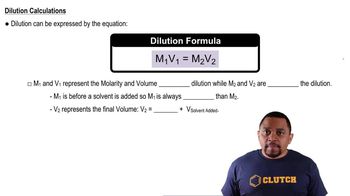
Solubility refers to the maximum amount of a solute that can dissolve in a solvent at a given temperature, expressed in g/L in this case. Understanding solubility is crucial for determining how much uric acid can be present in solution and for calculating concentrations in different units. The low solubility of uric acid indicates that it can easily precipitate out of solution, forming kidney stones.
Recommended video: