
Pearson+ LogoPearson+ Logo
Ch.9 Solutions
McMurry - Fundamentals of GOB 8th Edition
McMurry8th EditionFundamentals of GOBISBN: 9780134015187Not the one you use?Change textbook
Chapter 9, Problem 86

Emergency treatment of cardiac arrest victims sometimes involves injection of a calcium chloride solution directly into the heart muscle. How many grams of CaCl2 are administered in an injection of 5.0 mL of a 5.0% (m/v) solution? How many milliequivalents of Ca2+?

Verified step by step guidance
1
Determine the mass of CaCl₂ in the solution using the percent concentration formula: \( \text{mass of solute} = \text{percent concentration} \times \text{volume of solution} \). Here, the percent concentration is 5.0% (m/v), which means 5.0 g of CaCl₂ per 100 mL of solution. Use the given volume of 5.0 mL to calculate the mass of CaCl₂.
Convert the mass of CaCl₂ obtained in step 1 into moles using the molar mass of CaCl₂. The molar mass of CaCl₂ can be calculated as \( \text{molar mass of CaCl₂} = \text{atomic mass of Ca} + 2 \times \text{atomic mass of Cl} \).
Determine the moles of Ca²⁺ ions produced. Since each formula unit of CaCl₂ dissociates into one Ca²⁺ ion and two Cl⁻ ions, the moles of Ca²⁺ ions will be equal to the moles of CaCl₂.
Convert the moles of Ca²⁺ ions into milliequivalents (mEq). The milliequivalents are calculated using the formula \( \text{mEq} = \text{moles of ion} \times \text{valence} \times 1000 \). For Ca²⁺, the valence is 2.
Summarize the results: the mass of CaCl₂ administered and the milliequivalents of Ca²⁺ ions delivered. Ensure the units are consistent and clearly stated.

Verified video answer for a similar problem:

This video solution was recommended by our tutors as helpful for the problem above.
Video duration:
6m
Was this helpful?

Key Concepts

Here are the essential concepts you must grasp in order to answer the question correctly.

Mass/Volume Percentage (m/v)

Mass/volume percentage (m/v) is a concentration measurement that expresses the mass of solute in grams per 100 mL of solution. In this case, a 5.0% (m/v) solution means there are 5 grams of calcium chloride (CaCl₂) in every 100 mL of the solution. This concept is essential for calculating the total mass of solute in a given volume of solution.
Recommended video:
Guided course
00:38
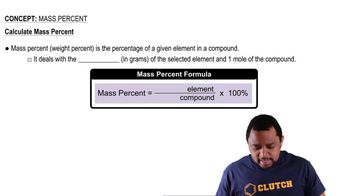
Mass Percent Concept

Calculating Grams from Volume

To find the grams of solute in a specific volume of a solution, you can use the formula: grams = (percentage/100) × volume (mL). For a 5.0% (m/v) solution, if you have 5.0 mL, you would calculate the grams of CaCl₂ by multiplying 5.0% by 5.0 mL, allowing you to determine the exact amount of solute administered in the injection.
Recommended video:
Guided course
03:12
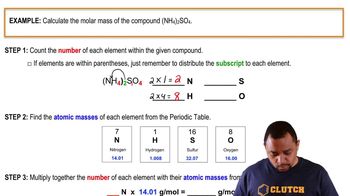
Calculating Molar Mass Example 1

Milliequivalents of Calcium Ions (Ca²⁺)

Milliequivalents (mEq) measure the amount of a substance based on its chemical activity or reactivity, particularly in relation to ions. For calcium ions (Ca²⁺), 1 mole of Ca²⁺ is equivalent to 2 equivalents due to its +2 charge. To convert grams of CaCl₂ to milliequivalents of Ca²⁺, you need to calculate the number of moles of CaCl₂ and then multiply by 2, reflecting the number of Ca²⁺ ions produced.
Recommended video:
Guided course
01:30
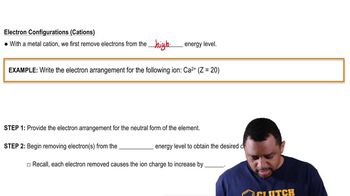
Ions and the Octet Rule (Simplified) Example 2